Showing posts with label spa. Show all posts

Friday, March 5, 2021

Going Down the Slippery Slope: Stone-pavement via Hatajuku on the 8 Miles Road of Hakone 箱根八里


Say, you ride a commuter bus around 9:00 from Odawara Station 小田原駅 to Onshi-koen Park 恩賜公園, start walking from there, and reach to Amasake Chaya Café 甘酒茶屋. Probably, it is around 11:30-12:00, lunch time at a nice historical Café with healthy menu, and lots of toilets. Many people decide their hiking is done here and ride a bus to Hakone Yumoto Station 箱根湯本駅 of Hakone Tozan Railway 箱根登山鉄道. Now! Let’s hike from Amasake Chaya to Hakone Yumoto with 8 Miles Road. The number of tourists ahead is smaller, if not “rare”, I tell you. Anyway, the stone paved route from now is relatively less trodden. This makes maneuvering on the road becomes trickier. You may think “?” I tell you why.

From Amasake Chaya,
we go down Prefectural Road 732 a bit to find
a signpost to return to the old pavement.
 The ancient road beyond these steps runs along #732.

Basically, Hakone is the area receiving more rainfall compared with the other places in Kanagawa Prefecture. When we check the up-to-date precipitation data online, Hakone stays in the top 3 spots regularly. The forests of Hakone are the mixture of afforested coniferous ever-greens and broadleaved trees. As we descend, we move to climate warmer and kinder to evergreen hardwoods. Inevitably, the stone-paved route in the forest receives less sun light and humid. If you’re interested in mosses and mushrooms, it’s an exciting place. But, when we plan to pick up the pace of walking, the condition is hazardous for hikers with uneven stones covered with mosses and continuously falling leaves. (Do you know evergreens shed their old leaves year-round?) I tell you, especially from Amasake Chaya, 8 Miles Road of Hakone is very SLIPPERY!

The paved way in a forest

Worse. The road is paved with hard-stone and runs on the precipitous slope of Hakone. If we fail to secure safe landing when we fall, there is a high possibility of suffering severe injury, like broken bones or concussion. Do you remember the photo last week, even before reaching to Amasake Chaya we avoided walk on the center of the paved road? That’s because we felt our knees tired and wanted to lessen the impact of hopping from one stone to another that looked safer. The sides of the paved route keep some ground soil so that it was gentler for foot of long-distance hikers … and the trekking road will be destroyed further because of our stamping … We know the environmental impact of our deeds. So, sorry, but our instinct for self-preservation wins. Now from Amasake Chaya, the number of hikers is smaller, and the space the side of the paved road, created by hikers, is narrower. And we’ve already descended along the stone-tiled route for about 3 hours. We continue 2-3 hours more of this, but harsher condition with hazardous moss-covered stones. You see my point? That’s why it’s so important to choose your shoes for this paved hiking course! I’ve witnessed many hikers before me over there slipped and had hard time to recover from the ground to proceed.

Please don’t get fooled by its “flat” surface …

8 Miles Road itself goes along the Prefectural Road #732. #732 winds quickly for cars to proceed steep slopes of Hakone. Compared to this, 8 Miles Road is for walkers continuing (relatively) straight. We often have to cross #732 and search for petit entrances in another side for 8 Miles Road to proceed. The Prefectural Road is a commuter road used frequently, if not congested, by cars. In this regard, we don’t have to worry too much getting lost. Occasionally we enjoy open mountain scenery of Hakone, of ancient and new volcanos, and Sagami Bay. During autumn, it’s so beautiful with colored slopes over there in yellow, red and green with blue Pacific Ocean ... Although we can here cars are coming next to us, the route is calm and serene in general. The atmosphere compensates our concentration on the moss-covered perilous stones …

Another side after crossing #732 could be some steps like this.
 Just keep on going,
 and soon we return to the 17th century pavement.

Old and new remnants of massive volcanic eruptions in Hakone,
 seen from the 8 Miles Road.

From Amasake Chaya, the local community called Hatajuku 畑宿 built houses here and there along #732. This is a historical community existing along 8 Miles Road of Hakone. At the beginning of Tokugawa Shogunate 徳川幕府 of the 17th century, theirs was a village of deep mountain where exhausted travelers asked some rest (and toilets!). 100 or so years later, they had cafés where the procession of feudal lords took rest and enjoyed elaborated mountain gardens. They even had (unofficial) brothels. According to one popular TV travelogue named “Bra-Tamori ブラタモリ” aired in October 2018, the Shogunate treated the villagers of Hatajuku well as they were informants watching for suspicious movement in and out of Edo (Tokyo) via Hakone. A-ha. The community of spies, then. In the 21st Century the place is famous as a hamlet of artisans for Hakone Yosegi-zaiku 箱根寄せ木細工.

Ichiri-zuka 一里塚 in Hatajuku.
 “Ichiri-zuka” is a signpost = “Zuka”
 built by Tokugawa Shogunate
 to mark “Ichi-ri” = 3.9km from the previous “Zuka.”
 This is the 23rd Ichiri-zuka from
   the beginning of Tokaido
東海道,
  Nihonbashi Bridge of Edo (Tokyo)
江戸日本橋
 (the bridge in front of the BOJ).
 This Ichiri-zuka was rebuilt in 2012
 after archeological study of the place.
 Once, such facility was used for travelers
 having a short break under the shade of big tree.

Hatajuku community in 2020

They have public toilets.

It was in the late 18th century when an artisan of Hatajuku named Ishikawa Jin’bei 石川仁兵衛 developed the technique to create craft objects, like jewelry boxes, plates, etc. using the ubiquitous trees in Hakone. I think it now becomes standard souvenirs for tourists to Hakone from all over the world. Many crafters of Yosegi-zaiku resides in Hatajuku community still. Hatajuku has museums and ateliers where we can learn the traditional crafts on hand and find souvenirs. You can decide to spend the rest of your day here and take bus to Hakone Yumoto for returning downtown Megalopolis (; the last bus will be at 20:41. Time table, here).

My Yosegi-zaiku box.
 I have it since I was a kindergartener …
 Maybe somebody gave it to me …

One of such shops to experience Yosegi woodcraft in Hatajuku
The ancient road continues between gardens probably of 200-300 years old …

From Hatajuku Bus Stop, the paved-road goes along with not only Prefectural Road #732, but also National Route 1. The historical road runs also with Sukumo-gawa River 須雲川. The level of slipperiness goes on strong. It continues for about half an hour, and the stone pavement finally unites with Prefectural Road 732 at Sukumo-gawa Bridge. From here to Hakone Yumoto Station, we walk #732, so please be careful of cars. Many hot spring inns start to appear. Area-wise, this is already the tourists’ spot of Hakone Yumoto 箱根湯本. Some spas allow day-trippers to enjoy short time stay. Some requires reservation in advance. To choose one, please refer here. Spa could be a nice conclusion for historical hiking in Hakone. Hakone Yumoto community has its own parks and forests, like I’ve visited for mushroom the other day. In future, I’ll report my another adventure in Hakone Yumoto. 😀

The paved road goes along Sukumo-gawa River.

The toilet near Sukumo-gawa Bridge.
 This is the end of the ancient road.
 From here we, walk #732.

And in no time,
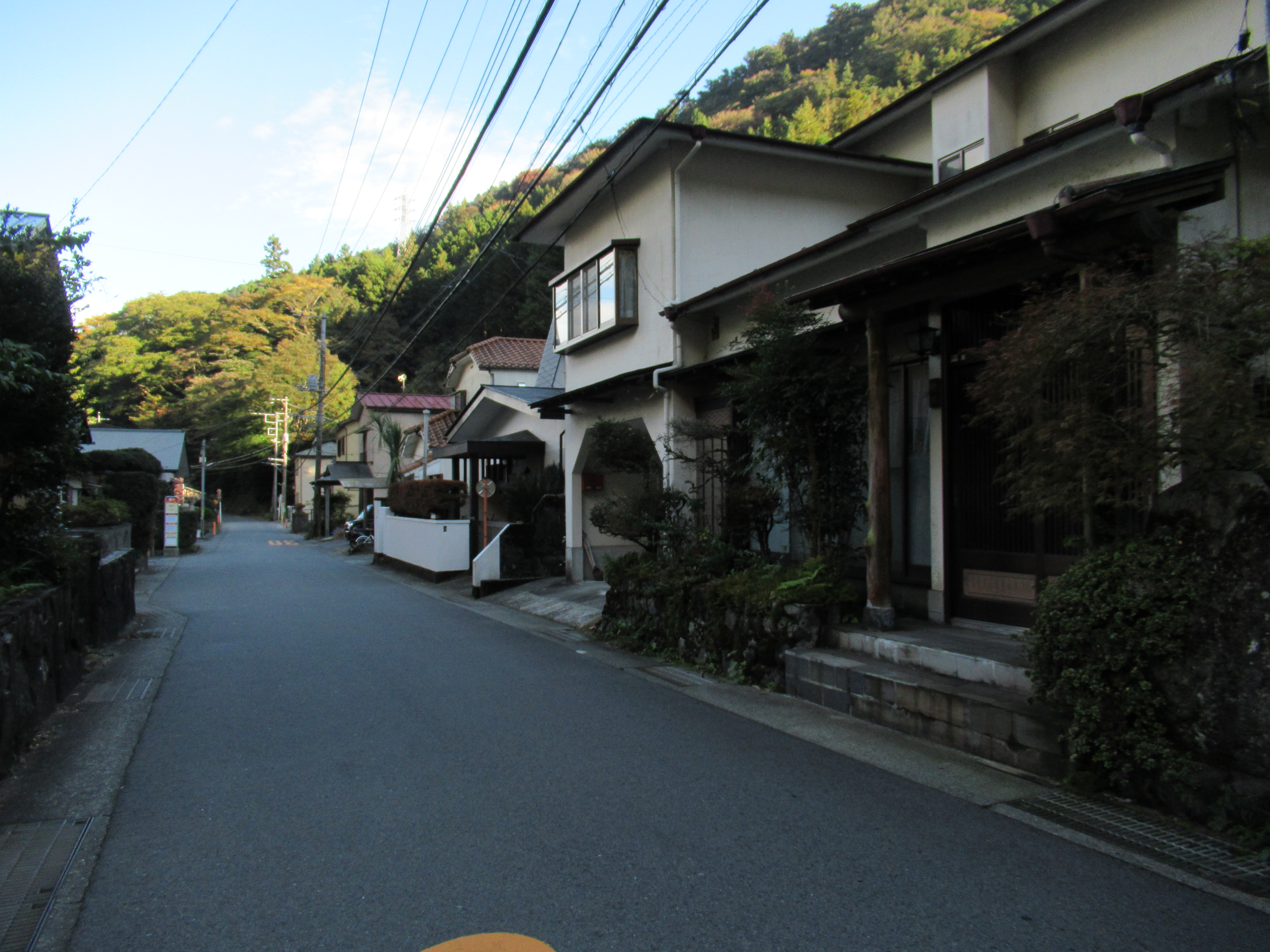
 we enter the present-day housing area of Hakone Yumoto.

Hakone Yumoto Station seen from near Hakone Town Hall.
 The end of our hiking today!

Oh, by the way, for 8 Miles Road of Hakone = Hakone Hachi-ri, “Hachi-ri 八里 = 8-ri” is supposed to be “1-ri * 8 = 3.9 km * 8 = about 32 km,” if we convert the unit in Shogunate official metrics. Our 8 Miles Road is not at all 32km. In classic Japanese language, “ri” often used for “long distance.” The historical road nowadays is about 8 miles that I found very convenient to translate “Hakone Hachi-ri 箱根八里” into English “8 Miles Road.” It seems to me, there are several explanation about the moniker “Hakone Hachi-ri.” The most legal one says the start of the road is Hakone Yumoto, and the end is Mishima 三島 in Shizuoka Prefecture 静岡県, whose distance is about 32km. The ancient route from Hakone Checking Station (箱根関所 roughly, our starting point for this hiking) to Mishima is none other than present day National Route 1, remodeled by modern civil engineering and always busy with lots of cars. Please pick your choice of the beginning / the end of the historical “Hakone Hachi-ri.” Cars? On foot?

Cute Himalayan spindles (Enonymus hamiltonianus) in Hakone.
 This makes white parts of Hakone Yosegi-zaiku …


If you find environmental issues in Hakone, please make a contact with Hakone Visitor Center, Ministry of Environment of Japan.

164 Motohakone, Hakone-machi, Ashigarashimo-gun, Kanagawa 250-0522
Phone: +81-460-84-9981
FAX: +81-460-84-5721
Email: hakone-vc@kanagawa.email.ne.jp
http://hakonevc.sunnyday.jp/shizenjyouhou/gazou/englishindex.html

Friday, February 16, 2018

Always Look on the Bright Side of Life: the largest Citizen Forest of Yokohama, Doshi Forest 道志村水源林


So, about silver lining after the voting incident in 2003 for Doshi 道志村 and Yokohama. In 2004, Doshi Village and the City of Yokohama established an official “Agreement regarding Friendship and Exchange 友好・交流に関する協定書 between the two, and Doshi Village became “Our Home Village for the Citizens of Yokohama 横浜市民ふるさと村.” The municipal budget of Yokohama has beefed up its grant for the welfare improvement of Doshi villagers. In 2006, Doshi Water Source Forests Fund 水のふるさと道志の森基金 was inaugurated by the Yokohama Waterworks Bureau. The fund is to solicit donations from the citizens and corporations to sustain further the exchange of people of two communities. The Bureau also sells bottled water “Hamakko Doshi the Water はまっ子どうし the Water” from Doshi River 道志川 to augment the Doshi Forests Fund. In 2014, two municipalities created a system to help each other in case a mega-natural disaster hit and the offices could not function to support the residents of each community. In 2016 Doshi Village has opened a café named Mizu Café Doshi 水カフェどうし in Yokohama’s downtown. The place is to introduce the village and numerous products from Doshi including fresh watercress harvested daily. Now the two municipalities jointly hold PR events about Doshi Water Source Forests year round. Yokohama Board of Education makes special programs for grade schoolers to learn Yokohama’s waterworks and the role of Doshi Village. When the people of Yokohama can show an ID mentioning our residency in Yokohama, Doshi Village offers numerous “Home Village” discounts for tourism attractions, such as hotels, meals, spas, sports facilities, etc. etc. And, the scheme introduced forest volunteers to help forestry in Doshi Village.


After the Agreement was signed
the City of Yokohama is actively involved with
utilization of woods produced in Doshi Village.
This is the decorative wall for Asahi Ward Office of Yokohama,
using the cedars of Doshi forests.
Water Café Doshi.
They serve beverages using Hamakko Doshi Water,
and hot meals with veggies and meats from Doshi.
There we can also purchase veggies,
smoked trout, jam, wood crafts, etc. of Doshi.
The place also provides tourism information.
Or, if you plan to start business or move in Doshi Village,
the café connects you with the village office
that can help you for paper works.
Matsubara Shopping Street 興福寺松原商店街where the café operates.
It is really in downtown Yokohama.


The land owned by Yokohama in Doshi is surrounding privately owned forests nearer to human settlement. These two areas form the system of water source that creates the amazing Doshi River 道志川. If private forests become a sorry state, even if Yokohama’s forests are healthy (which is unlikely; you know, the land is continuous), Doshi River cannot provide good water. Many of the private forests are afforested area whose coniferous trees require constant human engagement. Though, landlords alone cannot handle the works anymore. As Doshi Village faces aging and decreasing population, man-power to sustain the forests is in short supply. So, the City of Yokohama invites citizen volunteers who can help such grandpas and grandmas of Doshi for thinning and weeding. The City of Yokohama gives generous grants to forest volunteer organizations in Yokohama who can go to Doshi Village at least twice a year to do forestry. Moreover, in 2008 the city helped to establish the Association of Forest Volunteers for Doshi Water Source Forests 道志水源林ボランティアの会. The group is now engaging in forestry works in Doshi Village about 10 times a year. All the funding for the volunteer forestry comes from the Water Source Forests Fund together with a heavy involvement of Administration Office for Doshi Water Source Forests 水源林管理所. The policy is an amalgam of welfare measures for Doshi pensioners and water management projects, all funded by the City of Yokohama.


A part of forests where volunteers operate
had a colony of baby Lindera umbellate.They produce very fragrant oil.
It’s rare to find it in forests near population centers.
This was a kind of testimony about the environment of Doshi forests.


Actually, the Association for Niiharu Lovers 新治市民の森愛護会 is receiving the funding yearly. So, last fall I joined Niiharru Lovers’ activities in Doshi Village, paid completely by the Water Bureau of Yokohama. That was a gorgeous late summer vacation! We’ve been there by cars drove by the members of Lovers, and entered one of those privately owned forests of Doshi. We did thinning for 2 days with chainsaws to cut roughly 100 cedars of about 30 years’ olds. We stayed in an old traditional inn which was a house of a village chief decades ago, enjoyed open-air spa in a forest, and had delicious meals … sukiyaki with Koshu beef 甲州牛, BBQed freshly caught trout from Doshi River, tempura of mountain vegetables, etc. etc. I was knocked out, and on a sort of “the spur of the moment,” became a member of Association of Forest Volunteers for Doshi Water Source Forests.


Niiharu Lovers are ready for action in Doshi forest.
Lunch. I was a particular partisan for omelet.
Niiharu volunteers are in action.
Hikari-so Inn 光荘 where we stayed.
The house is equipped with a traditional Japanese hearth,
called Irori
囲炉裏.
Look!
The forest floor is receiving sun light after our work!


The Association goes to Doshi Village from April to October by charter buses hired by the Water Bureau of Yokohama, and engages in forestry works mainly by non-powered tools, like handsaws and sickles. In case you consider joining volunteer works for Doshi Water Source Forests of Yokohama, you can send an email to the Association from here. The forestry activities are basically for members only, but the Association allows visitors to try it once. RSVP. Any activity with the Association is free, including transportation to the Village. (Remember? It costs about USD 100 for a return ticket.) On the activity day, you have to come to the north exit of Kan’nai Station 関内駅 by yourself to catch the chartered bus, don the attire for forestry, and bring your lunch + water + snacks. I could slip in myself for one of their last activities of 2017, sweated in thinning within a clean and calm autumn air of Doshi Village, and enjoyed shopping for mountain products at their main shopping venue. … After this fun in Doshi, I did a little study whose result was reported during the last several posts of this blog … So, here I confess. Though I told you the story like I have known the relationship with Doshi Village and Yokohama for years, I did not. I was one of those city rats skeptically hearing the requests from the people of Doshi to be a part of the city of Yokohama. … Now, when the new fiscal year begins in coming spring, I will visit Doshi Village regularly as a forest volunteer. I know I’m a minuscule in front the Doshi Water Source Forest, but I think my saw-works would be better than nothing for the people of Doshi and the water for our community. 2873ha Doshi Water Source Forest is the largest Citizen Forest of Yokohama.


Association of Forest Volunteers for Doshi Water Source Forests
can use the facilities Yokohama’s Water Bureau has
in Doshi Village.
Cut somewhere here.
Oh, by the way, Japanese way is conventional face notch.

Doshi Michino-eki Shopping Lodge 道の駅どうし.
Michino-eki is roadside stations providing
resting places and shopping opportunities for drivers.
It’s a part of rural development project funded by
Ministry of Land, Infrastructure, and Transport.


… A postscript: last November, I have completed the course for becoming Kanagawa Forest Instructor, and received from the Governor of Kanagawa Prefecture a letter of appointment to a forest instructor. Now one of my missions is to let the people like me know Doshi Village has sacrificed so much for us in the city, really.


Doshi Village Office 道志村役場

6181-1 Doshi Village, Minamitsuru-gun, Yamanashi, 402-0209
402-0209 山梨県南都留郡道志村6181-1

Phone: 0554-52-2111
FAX: 0554-52-2572

http://www.vill.doshi.lg.jp/

Friday, September 22, 2017

Baby trees in Mad Max 3: planting trees in the place of Neon Genesis Evangelion


Kanagawa Green Trust かながわみどり財団 has a year-round program for anybody to join forest management in Kanagawa Prefecture.  Once to three times a month, they organize a field trip to a forest for planting, mowing, thinning, pruning … you’ve got the idea, haven’t you? The majority of event-dates are during weekend + the place is mainly a public land that is normally off-limit.  It’s a good weekend getaway from urban life. The Trust arranges a free bus tour to the site from a commuter train station of Odakyu Line 小田急線. And so, your transportation cost is minimized. Volunteers make an online reservation (; you can reserve your seat for an event here), then, on the reserved day, wear mountaineering gear (a pair of work gloves is a MUST), carry your lunch and lots of drinking water, and go to a meeting place normally within 5 minutes’ walk from a designated train station. The rest is taken care of by the Green Trust and Kanagawa Forest Instructors. The forest activity is for the morning. After lunch in the forest, many events are over and the Trust brings you back to the commuter train station. Sometimes additional program is arranged such as meeting with local forest volunteer organizations, or free spa in Hakone 箱根. Actually, if a forest is in Hakone, it is a HUGE bargain to visit a forest of Hakone! They say the program is gaining popularity these days and seats for some date become rapidly full. The purpose of this tax-payer funded fun is to provide opportunities for urbanites to know forest management hands-on, and to manage vast water catchment forests of the prefecture in whatever way. As such, the forests chosen for the program is often for water conservation in Tanzawa and Hakone. For the water source forests in Tanzawa, I’ll post you my experience there soon. Today, I tell you my experience with continuing afforestation efforts in Sengoku-hara 仙石原 of Hakone. Although the area ceased to be the water source for the City of Odawara 小田原, the place still provides water to the community in northern Hakone. A weekend forest activity concluded with relaxing free spa is, I tell you, gorgeous.


The gate of off-limit prefectural forest in Hakone.
It’s open only for the time of forest management.


Hakone is one of the most prestigious resort towns in Japan. Inevitably, there are several golf courses. Among them, Hakone Country Club in Sengoku-hara is the place for rich and famous in Japan to enjoy their weekends. In the premise, they have several ponds, of course, but one of them, the largest, is not for golfers.  Its name is Itari Pond イタリ池. It is one of the remnants of a marsh spreading in the northern Hakone area until some 70 years ago before the place underwent a massive resort construction. In 1959, another remnant, the Sengoku-hara hygrophyte meadow was designated as a National Natural Treasure of Japan. The meadow attracts lots of visitors, contributing to the tourism business of the town. Aside from being scenery of rich golfers, Itari Pond too is sustaining the economy of the area in a very practical way. The people in Sengoku-hara area pump up the water of Itari Pond (about 700m ASL) to 2.5km south of Owakudani 大涌谷 (about 1050m ASL) and let it through the well of volcanic steam. The H2O becomes mineral rich boiling water and comes down to northern Hakone to be spas. So far, it never fails to provide lots of lots of spa water. No wonder. The area is the source of Hayakawa River 早川 pouring to Sagami Bay 相模湾 in the south of Odawara City. It is the river supplied water for some 400 years to Odawara, although since 1936 Odawara is using water coming from Tanzawa Mountains.


Over there is Hakone Country Club.
According to Neon Genesis Evangelion,
this is the place for Neo Tokyo-3.
At least for now,
the majority of strollers in the premise are not millennials,
but their parents or grandparents.
(In any case, we have survived 2015 …)
Hakone Yumoto 箱根湯本 and Hayakawa River

The reason why Odawara switched its water source was, Hayakawa River could not fulfill the demand any more. There was population growth of course, which made even the rich marsh of Hakone could not satisfy people’s satiation. You may say Sengoku-hara is right next to Lake Ashinoko 芦ノ湖 that is the source of Hayakawa River anyway. The lake can take care of the matter, can’t it? Well, yes and no. The water right of Ashinoko Lake is held by Shizuoka Prefecture 静岡県, not Kanagawa, because of historical reasons originated in the 17th century. Based on the present-day law, the civil engineering maintenance for the lake is under the jurisdiction of Kanagawa Prefecture, but the water of Ashinoko Lake must go to Shizuoka via Fukara Canal 深良用水 which holds the title of International Heritage of Irrigation Facility, designated by International Commission onIrrigation and Drainage. So, Kojiri Watergate 湖尻水門 in Sengoku-hara leading to Hayakawa River is permanently closed. That’s that. In any case, I suspect one of the reasons for the 20th century water shortage from Hayakawa was environmental. Here is a photo, borrowing from the homepage of Hakone Shrine. It shows how Sengoku-hara area was in 1949 when the Emperor Hirohito came to hold an afforestation ceremony. The marsh was not that much wet but more of dry grassland. Water retention was definitely lower in 1949 comparing with 2017 when the area is fully-afforested.


In Itari of Sengoku-hara meadow, spring 1949.
Actually, Japanese Emperor presides over
the annual afforestation festival since 1934,
importing the American idea of Arbor Day.
The festival could not be held in 1944 and 1945,
but otherwise it has been one of the most important
official duties of the Emperor
.
This year, the event was held in Toyama Prefecture.
Sengokuhara meadow, in summer 2017


For more than 70 years of continuous afforestation, the former grassland is now a forest (and 2 golf-courses).  First, people planted coniferous trees there. They are now matured cedars and cypresses many of which are harvested for funding nature management programs of the Prefecture. This spring, in the forest management tour we planted next generation trees to the newly created vacant plots in Itari area of Sengoku-hara. The site is now managed by Kanagawa Water Supply Authority 神奈川県内広域水道企業団 in order to supply water to the northern Hakone area. The chosen seedlings this time were deciduous trees, nurtured from the local seeds of Stewartia monadelpha (Tall stewartia), Acer palmatum (Japanese maple), Cerasus jamasakura (Japanese hill cherry), and Cornus kousa (Kousa dogwood). Before we arrived, The Water Supply Authority cleared the place and marked the place with a bamboo stick for the seedlings to be planted. Although, Hakone area does not (yet) suffer deer problem, the place was enclosed by sturdy wire mesh to prevent deer lunch, just in case. Everything was ready when we went there. We simply dug at the indicated point holes deep and wide enough for the roots of seedlings to be covered with 2-5 cm of soil and applied gentle stomping around the root to stabilize the soil (; it’s a maneuver similar to a dance around a small poll, which I loved). Then, each baby tree was loosely tied to the bamboo cane with a hemp yarn. The fastening of the seedling is important to prevent the weak babies to be knocked out by strong winds and rains. The point to apply yarn is at 2/3 of a seedling from the bottom.  We put the string in 8-shaped loop around the marker-stick and tied the end at a seedling, not so tight but secure enough for the fastener to stay at the point. The baby trees grow taller and spread their branches from their growing point, normally at the tip. The trunk 2/3 from the root will not have a new bough anymore, but only get thicker. So, gentle tying with a yarn will not hamper their growth.


The underground reservoir that gathers water in Itari forest
A tag attached to a seedling.
 There is an interesting story about such switch in afforestation
from coniferous trees suitable for mass market
to
locally procured broad-leaved trees.
I tell you about it in my later post
together with the thing of grassland and the forest;
they are related.
It’s the water purification plant for northern Hakone.
Not that huge, isn’t it?
After the planting we had a tour in the water purification plant.
The water from Itari forest is not contaminated,
but the plant is to make it sanitary.
Bacteria, poops of wild animals, etc, etc., you know?
Interestingly,
the purified water is slightly acidic
due to volcanic activity of the area.
In order to make the taste
acceptable for the majority of the tourists,
the Authority adds baking powder
for neutralization before distribution.


Our senior Forest Instructors said, “What fascinating in afforestation is, we imagine how these babies grow. Here, the sun light comes from this direction so that these thin branches near the growing point will take a shape to receive the max energy from the sun in such way (he explained by body language). The direction of the tree to get taller will also be affected by the direction of sun. Then, there will be a race for survival not only among these seedlings we planted today, but also with weeds and wild seedlings now dormant in the soil but will come out sooner. All compete for the max sun shine, and water and nutrients underground. Taking care of the planting site is watching a gradual change of the natural community where we brought the seedlings. Sometimes, our first expectation will be completely off target because some seedlings could not survive for their first few years. Others could have a shape we did not expect originally. Some became spectacular, another just mediocre. We know we cannot live long enough to make it sure how the most successful baby tree becomes in hundreds of years. That’s the best part of afforestation, realizing such things by attending the same forest for a long time.”


They are about 70 years’ old trees in Itari.


In the event of forest management by the Green Trust, we returned the same place during summer for mowing. Certainly, the seedlings we planted were surrounded by tall weeds and in a competition with wild seedlings such as Japanese pepper (Zanthoxylum piperitum). “Please mow all except the planted seedlings!” OK. When I cut the pepper tree, the air was filled with the pure aroma of Japanese pepper … piquant and a hint of fresh mint. Do you think mowing them wasteful? Well, I’m sure when we return the same place next summer, another wild Japanese pepper trees are establishing themselves no matter what. The caged afforestation field in Hakone is the place for the survival of the fittest.   Very Mad Max place. Welcome Aunty Entity.


The afforestation site in August.
The wild weeds are dominating the place.
After mowing.
The baby trees can take a breath now.
In the established coniferous forest of Itari,
in August wild Hydrangea macrophylla had very large buds everywhere.


If you find environmental problems in Hakone, please make a contact to the Visitor Center of Hakone National Park
 
Hakone Visitor Centre, Ministry of Environment 環境省 箱根ビジターセンター
164 Motohakone, Hakone-machi, Ashigara-shimo-gun, Kanagawa, 250-0522
250-0522 神奈川県足柄下郡箱根町元箱根164
(TEL) 0460-84-9981
(FAX) 0460-84-5721
(Email) hakone-vc@kanagawa.email.ne.jp
http://hakonevc.sunnyday.jp/