Friday, October 18, 2019

Disturbance; Typhoons Faxai and Hagibis for Yokohama’s Forest


This year so far, Kanto Region has had two uber-destructing typhoons. One was Typhoon Faxai on September 9th, and another was Typhoon Hagibis on October 12th. Both gave us a heck of scenery in our forest. Let me show you what they did.


In Niiharu 新治市民の森, the slopes facing to north-east received a ton of mess after Typhoon Faxai. The slope in front of the Satoyama Civic Center had lots of broken trees and bamboos, large and small, like this.


Also in Niiharu, our chestnut orchard had a substantial damage. It was just before we would have harvested this years’ nuts. Many trees have been wrung their trunks in the middle by strong winds, with not-yet-open burrs. Currently, Lovers of Niiharu is discussing with the City if we have to deforest the slope, and replant chestnuts, or else, from a scratch. I’m SOOOOOOOOOOOOOO sad we cannot harvest Niiharu’s chestnuts this year. The taste of these trees was definitely earthier and richer than that of supermarket version. Baking chestnut cake from them was becoming my annual ritual … One of my seniors consoled me. “Naomi, it is said 3 years for chestnuts and peaches. You wait for only 3 years.” I will. *sigh*


Bamboo forests in Niiharu also became a jumble with Faxai.


Basically, cedars and cypresses are the species which do not take their roots deeply in Japan. So, when strong winds, like 50 meters/s (180 km/h), hit their sweet spot, they are turned over from the root, like here.


Cedars and cypresses can be snapped easily as well, like this found near Yokohama Zoorasia. One of the reasons they are loved by foresters is they are soft so that it’s easy to process them for building materials. With super typhoons, their merit becomes their weakness.


So, it was shocking to me to find out hard but elastic Quercus myrsinaefolia were broken here and there, just like conifers. They looked so large and mighty, but …

The condition is worse for Segami Citizen Forest 瀬上市民の森. Typhoon Faxai not only broken trees but brought lots of land slides there. At this moment, almost all their walking routes for visitors are off-limit. One of my friends who is a member of Segami Lovers told me they were also shocked to see their rice paddies are filled with the soil avalanche. “You see? We were planning to harvest rice several days after September 9th, and now this. All the crops of ours are damaged. I guess Segami’s fireflies are also experiencing disaster to survive … I’m not sure if we can enjoy their night dance next June …” Cities of Kamakura and Hayama have black outs both with Faxai and Hagibis due to strong winds and land collapsing with torrential rain. These places are very near to Yokohama’s South Forest, including Segami Forest. Segami Forest could have another fresh landslides after Typhoon Hagibis ... I don’t know … I won’t see her till next week ... As landslides and flood can happen long after the storm passes, the place would be vulnerable at least till the end of October … The Lovers of Segami are currently very busy to clean up the aftermath. I guess they are having a hard time … We Niiharu Lovers are also crisscrossing our forest to tidy up the situation at least along the trekking routes for visitors. This is a mighty task, I tell you.


You see? This cherry tree was broken in the middle by Faxai. And below is a popular promenade. Lovers of Niiharu took care of the situation.


This one is definitely to be removed. We reported the situation to the City. We hope they will treat the matter promptly.


A falling cedar, even if it’s just less than 30cm of diameter, can broke a concrete fence with a ∅2cm iron mandrel, as such.


Typhoon Hagibis made almost all the trekking route of Niiharu Forest into tiny streams, sometimes with gushing water. This photo was taken in our proud forest of ferns. I was a sort of convinced why this part of Niiharu has diverse colonies of ferns. It must have sufficiently high underground water levels that can come out when it’s ready, like this.


After Typhoon Hagibis, Niiharu Forest suddenly had lots of small ponds here and there. Thank God, we didn’t have floods and landslides like elsewhere.


At the beginning when I saw dramatic scenery with super typhoons this year first hand, I was astonished and thought about the tasks we had to do to tidy up the mess. Then, I realized it’s just a part of life for forest. There even is a moniker to describe such things, aka, Disturbance. Yap. Forest needs such things. When a large tree is snapped, the sky it blocked for the undergrowth suddenly open. Who knows what kind of vegetation comes out next spring in newly created “Empty” space? Extraordinary amount of rainfall due to global warming may have changed the underground water system for Niiharu’s forest of ferns. That’s something larger than the argument between professors and Lovers of Niiharu about mowing there. Amazing. We humans are just a tiny part of forests. I have to remember it.


Regarding Yadoriki Water Source Forest, Kanagawa Forest Instructors have information of substantial damage by Typhoon Hagibis. With Hagibis there have been several deaths in Kanagawa Prefecture by engaging with surged streams in the mountains. I guess Yadoriki Stream has changed its face dramatically again. Prefectural Office is warning us not to go there until they complete the damage assessment. As of today, I have not been there so that I cannot tell you the situation with my own words. I’m planning to go there to see the forest by myself, once the weather becomes more stable. Today, it’s raining hard again. I can see an egg of typhoon might be growing off Philippines with satellite data … PLEASE DO NOT ENTER YADORIKI WATER SOURCE FOREST until the safety is assured. I will report the situation once I have a chance to go there.


A gap in the forests’ canopy. A new day is born.

If you find an environmental issues in Kanagawa Prefecture, please make a contact with Kanagawa Natural Environment Conservation Center 神奈川県自然環境保全センター

657 Nanasawa, Atsugi City, 243-0121 〒243-0121 厚木市七沢657
Phone: 046-248-0323

You can send an enquiry to them by clicking the bottom line of their homepage at http://www.pref.kanagawa.jp/div/1644/

Friday, October 11, 2019

Counting days: Formula for the best date of fall hiking in Kanto Region


We’re already nearing to the middle of October. But we can still spend our days with half sleeves in Yokohama. I personally think the weather now is that of September before, or immediately after the end of summer vacation when we were grade schoolers. Still, it’s something like compulsory to regard October as “middle autumn.” Travesty. We should accept the reality. And so, weather in October 2019 could be viewed as the end of summer! To prove the point, let me refer the temperature data for the last 30 years …


Though, persimmons are getting redder these days
 in an orchard of Niiharu
新治市民の森.


Er, well, this is the standard course of discussion when we talk about climate change, right? Recently, I’ve learned there is another curious way to look to the matter. In 2007, Japanese Meteorological Agency notified the public that they changed the way to calculate an expected date for the best autumn leaves in Kanto Region. Until then, they employed the data collected during the 1960s, and used this formula:

The expected days from October 1st for autumn leaves to be the most beautiful in Kanto Region
= 3.99*(Average Temperature of the location during September of the year) – 43.61.

In 2007, using the data for 2002-2006, they changed the coefficients of this formula like

The expected days from October 1st for autumn leaves to be the most beautiful in Kanto Region
= 4.62*(Average Temperature of the location during September of the year) – 47.69.

Inevitably, it’s much later for the best days of autumn hiking in forests of Metropolitan Tokyo area, compared with the days when the Beatles existed. Then, when should we plan to go out this fall?


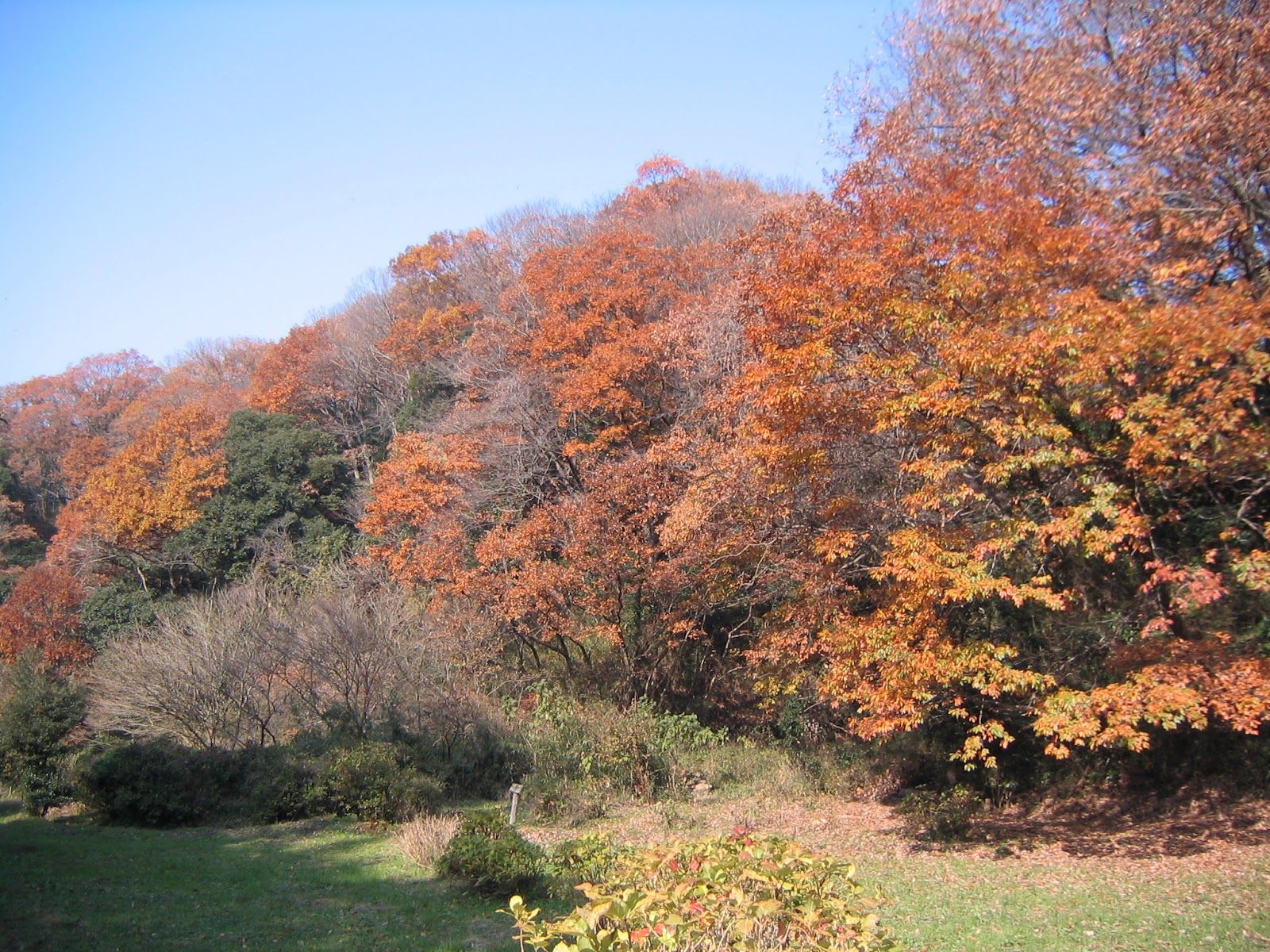
When can we encounter this for 2019?


I’ve done a math. For Yokohama, we can take out the temperature data for September 2019 from here, and the average turned out to be about 26°C … No wonder we felt it was hot last month. Plugging in this number into the above formula, the expected days is approx. 72, i.e. 72nd day from October 1st. That is to say, we must wait till December 11th to welcome the best forest scenery for autumn leaves … Hey, it’s almost Christmas, aka winter, isn’t it? Mmmmmmmmmmm …


I’ve just noticed it was like that 4 years ago.
 This is a photo I took in Segami Citizen Forest
瀬上市民の森
 
in the middle of December 2015.
 More to Segami Forest next week!


Just being curious, I also counted the days for Doshi Village 道志村 whose average temperature in September 2019 was about 23°C which could be something Yokohama had 50 years ago in early fall. With this average figure, the days to be tallied becomes 60. i.e., In Doshi Village we could have the best colors for fall 2019 on 29th of November. Well, it’s at least still in a month categorized as “autumn.” How about Yadoriki? I used the data for Minami-Ashigara City 南足柄市, a neighboring city for Matsuda Town 松田町 where Yadoriki Water Source Forest やどりき水源林 resides. The forecasted best day for autumn leaves will be on December 4th. Please take your pick and mark the calendar for fall hiking with hot chocolate this year. It’s about two months from now … Long hot days ahead. *Sigh*


A Japanese zelkova (Zelkova serrata) has
 started to change the color of its leaves
 early this October in Doshi Village.
Yadoriki was like this last late November …


If you find an environmental issues in Kanagawa Prefecture, please make a contact with Kanagawa Natural Environment Conservation Center 神奈川県自然環境保全センター

657 Nanasawa, Atsugi City, 243-0121
〒243-0121 厚木市七沢657
Phone: 046-248-0323


You can send an enquiry to them by clicking the bottom line of their homepage at http://www.pref.kanagawa.jp/div/1644/

Friday, October 4, 2019

Make Ramen Noodles with Bamboos at Shinyokohama Raumen Museum 新横浜ラーメン博物館


You might think bamboos are elegant, understating, very-Japanese “trees.” Botanically speaking, they are grasses, not trees, as you may know. Anyway, yes, they could be “very-Japanese.” Bamboos are aggressive invaders. When they see an opening nearby, their underground stem relentlessly spread further and further. That’s why every spring we find bamboo shoots sprouting from totally unexpected places. If bamboos are left alone, they multiply and dominate the field by killing-off the other species which are there long before the bamboos come. We Lovers of Niiharu Citizen Forest 新治市民の森愛護会 are fighting to control their invasion. Our approach is CUT and DIG. Every spring we dig out bamboo shoots. It’s a fun activity, i.e. harvesting spring delicacy from the forest. (OK, OK.) We also thin bamboos all year around, literally. Traditionally, thinning bamboos is to be done in autumn. After summer, their speed to “drink” water becomes slower, and so the cut trunks and stems are drier. It is less likely for molds, viruses, etc. to enter them, and so people can treat them as materials to make household utensils. Though, these days in the City of Yokohama bamboo forests are literally out-of-control. We take thinning operation all year round, including summer. Tons, really tons of bamboo trunks and boughs are supplied after our forestry activities all year round. Here is THE problem: what to do with those trunks, stems, leaves of cut bamboos?


A scenery in Niiharu Citizen Forest.
 Believe it or not,
 this place was supposed to be a forest of cedars,
 some 50 years ago …
 But now, everybody calls the place as “bamboo forest.”
 Sigh*


Before, Japanese fully utilized cut bamboos for household utensils, like bamboo basket, cooking spoons, chopsticks, etc. The plant could provide good materials that require flexibility. Now almost all such tools are replaced by mass-produced merchandizes made of petrol, or imported cheaply from somewhere. The cut bamboos have lost the place to be useful after thinning. In Yokohama’s Citizen Forest, the City Office tells us to collect the cut-trunks et al as garbage. Some % of bamboo “garbage” are processed to be chips for mulch. The majority are incinerated emitting CO2. Frankly, it’s a waste of resources … But what else can we do when a Chinese-made cooking mesh is $1, and a Japanese traditional bamboo basket is $30? So, when I heard there is a cooking event to use bamboos trunks, yes! TRUNKS, I was curious. I know Korean tradition has a way to process salt using bamboo trunks. They pack salt inside the bamboo and bake charcoal. The salt “cooked” in this way is expected to absorb extract of bamboo which is thought to be good for health. Koreans use it as an ingredient for traditional medicine … not exactly for cooking. But this one I’ve encountered was to “Make Ramen Noodles with Bamboos” at Shinyokohama Raumen Museum. ?????


Shinyokohama Raumen Museum. It’s located almost next to the Nissan Stadium
where on November 2nd the Championship Match
 will be held for 2019 Rugby World Cup.


Do you know Ramen? It’s that noodle soup we can find in supermarket as staple for college freshmen. We Japanese have thought it was imported from China 100 or so years ago. These days many Chinese visitors to Japanese ramen restaurants say like “Oh, this TRADITIONAL Japanese ramen is certainly different from supermarket version!” … We’re gradually changing our perception of “Ramen = foreign but familiar food” to “Ramen = maybe we contributed quite a lot to be like that.” Perhaps making ramen noodles with bamboo is a very-Japanese thing ... Supermarket ramen noodle is dried, but of course there is fresh versions just like fresh pasta. Recently, Raumen Museum had a demonstration to make fresh ramen noodles using bamboo trunks. First, they explained us the way to use bamboo trunks to make noodles would be invented by Chinese some 1500 or so years ago. (So, in the end the methodology was imported!) In Japan, the way started to be used during the last days of the 19th century for ramen noodles. (Hmmmmmmm, this “imported-technology-modified-in-Japan” process is VERY-Japanese.) Especially in Sano City 佐野市 of Tochigui Prefecture 栃木県, it is common to make ramen noodles using bamboo trunks for at least last 100 years. (Well, it becomes Japanese tradition, then.) Raumen Museum’s event was by ramen artisans studied in Sano City making ramen noodles. They let us try their way. The bamboos we used were harvested from a nearby bamboo forest in Kohoku Ward 港北区 of Yokohama. (That could be a new way to utilize thinned bamboos!) It was fun to make ramen noodles with bamboo, I tell you. In the below photos, I explained what we did.


Our working bench.
 Could you see the bamboo trunks set against the wall?
 Those are the main tool for today.
 Please take notice the bench has a tiny shelf at the end
 whose below is a strategically created space for this cooking method.
Also, sections of bamboo trunks are shaved to provide a flat surface.
 This is an important point.
First, the Museum already provided us 300g flour and 100g “Kansui” water.
 Kansui is a mixture of sodium carbonate and potassium carbonate.
 When we dissolve it in H2O and use to knead dough for Chinese noodles,
 it could give that particular texture for the pasta.
 (Detailed amount of flour and Kansui Water for ramen noodles can be found here.)
Our instructor advised us to sprinkle the Kansui Water
 evenly to the flat-out flour in a large bowel.
Mix the flower and water by hand.
 The content of a bowel will soon become flakey,
 just like a pie dough. Then,
Start kneading the mixture until
it becomes exactly like a bread dough.
In order to prevent the dough from drying out,
 we place it in a plastic bag and rest it for 15 minutes.
After 15 minutes waiting, take out the dough from the bag
 and place it on working bench sprinkled with flour.
 The fun begins from here!
We can allow generous usage of flour for kneading.
 All in all, the way to work with bamboo trunk is dynamic.
 Just be brave!
Flat out the dough ball ...
here.
Then, set the bamboo trunk above the dough, like this.
 Could you see the usage of the space below the shelf?
 It becomes the stopper of a bamboo lever.
Set the bamboo trunk as such and … 
put your thigh on the bamboo.
 It seems to me you should remain your dominant foot on the ground.
 Reason?
 From this point, it’s a jumping exercise!
Let’s flat out the dough by pressuring it
 with bamboo trunk by hopping on one foot.
 Caution: we need to be careful to secure
 the other end of the bamboo always nicely under the space below the shelf.
 Otherwise, serious injury could occur
 by falling on our backside with a flying large bamboo trunk!
Flatted dough is to be folded in half, and
We hop again.
2nd flatted out dough is carefully opened,
 folded in half in 90
° degree direction, and
pressed gently with the bamboo trunk.
When we open the 3rd flatted dough,
 the dough is now a larger but slightly thinner circle
 than the beginning.
Fold the now flatter dough in half,
 then fold the edge again to the outer direction.
 The prepared dough should be looked like this. 
Then, we hop again.
We repeat this folding and hopping with the bamboo trunk
 until the dough has 2mm thickness.
 As the dough increases its acreage,
 folding becomes 3 or more times, as we can see here.
The 2mm thick dough I kneaded.
 The process was like an exercise in gym.
 The done dough is folded again neatly and placed in a plastic bag.
 We wait another 15 minutes before
we bring them to the cutter.
 The staff of Raumen Museum cut our dough to be noodles.
 From 300g flour, it became ramen noodle for 3 servings (360g).
They cook the fresh ramen noodle (120g) …
My ramen noodle will be ready in 2-2.5 minutes.
The point to cook fresh ramen noodles is,
 treating them gently but quickly.
 First, we drain water, and
shake the basket twice or so gently.
Cooked noodles are placed in a soup,
 then topped with minced leeks to
be a standard ramen noodle soup with soy-source base.
 Boiled pork, narutomaki, and Shungun (bamboo shoot cooked in Chinese way) are optional.
Thank you for the Ramen!


Raumen Museum of Shinyokohama is planning this “Making ramen noodle with bamboo” to be the next attraction for visitors (3000 yen or 1000 yen per 1-1.5 hr session). RSVP. They have started to take reservations from October 3rd, and the first date of the event will be on October 17, 2019. Please go to their HP to make a reservation. They are mulling to provide English reservation site, but at this moment, the HP is in Japanese only. You can send an email, or call them for the enquiry. This is a very popular tourists’ spot for overseas visitors as well so that I believe they can answer your question at least in English. Please experience the smooth touch of bamboo for ramen!


Shinyokohama Raumen Museum
2-14-21 Shinyokohama, Kohoku-ku, Yokohama, 222-0003
Phone: 045-471-0503
Email: eisen@raumen.co.jp