Showing posts with label Bamboo. Show all posts

Friday, April 21, 2023

Bamboo shoots in the new era? 2023 bamboo shoot harvesting in Kanagawa Prefecture


A bit strange this spring is not limited to cherry blossoms. The case in point is bamboo shoots, aka Takenoko. I don’t know how professional Takenoko farmers do for stable production of their produce. But, in general in Kanagawa Prefecture, bamboo shoots that can be harvested from bamboo forests managed by volunteers have a sort of pattern in annual yield. It alternates bumper and poor years. We volunteers dig bamboo shoots not for harvesting ag produce, but for controlling the wild spread of bamboos that can damage the ecosystem of entire forest. Poor year is poor year, and we accept it philosophically. Last year, 2022, was a bumper year. This year was not much. OK. Then I noticed a bit strange thing in bamboo forests. It’s not about bamboo shoots but the ground.


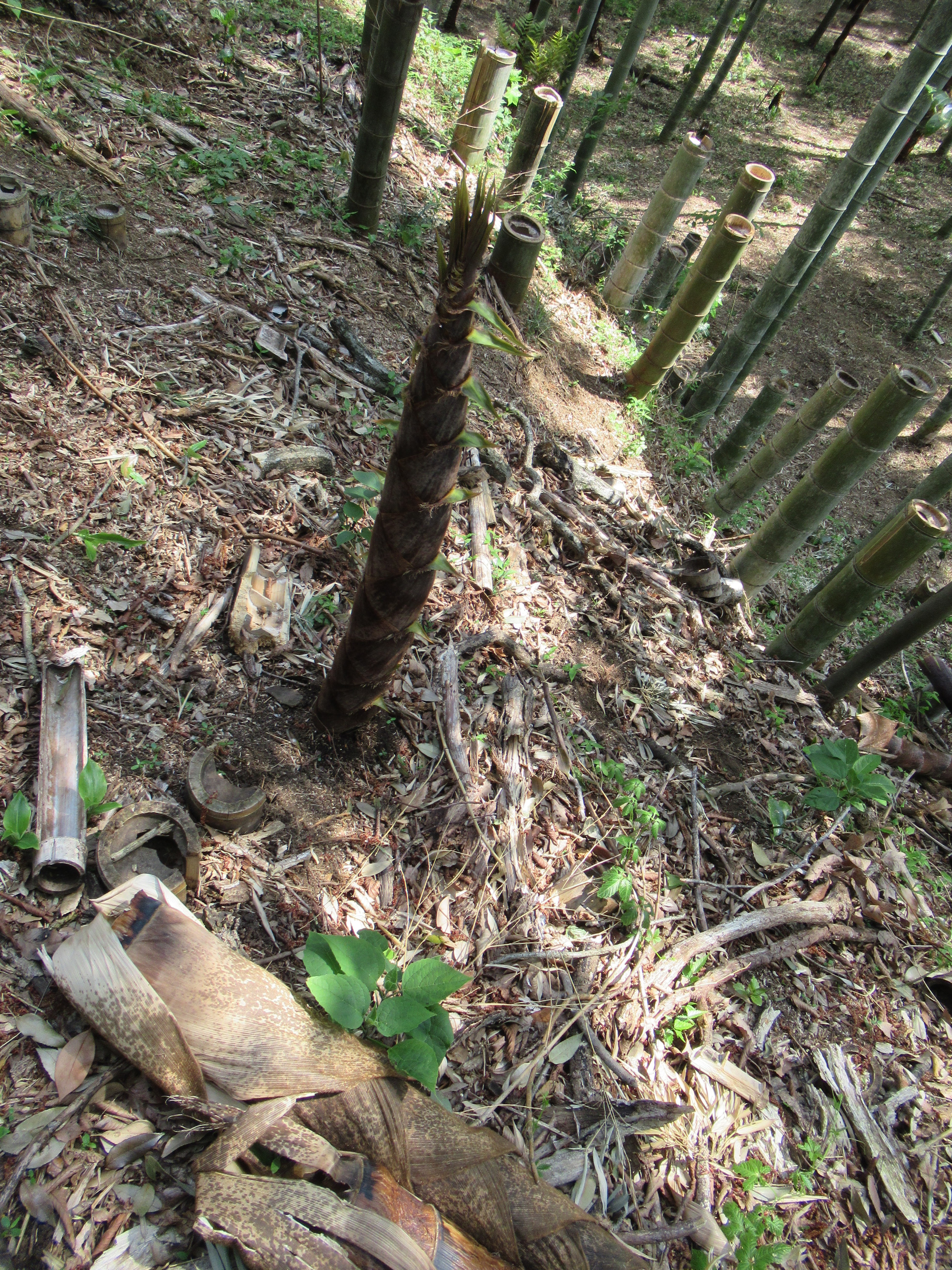
As I told you in my post for May13, 2016, for digging up bamboo shoots, we remove soil around the shoot, then strike down the root part. How deep we have to dig is actually not much regardless of the size of the shoot. It’s about 20cm or so deep and we reach the connection point of the shoot and its underground rhizome. When we meet with that joint, it’s time to strike and remove the shoot from the rhizome. This year, I noticed when we dig the ground around a shoot, the soil that is moist is top 5cm or so at best. Below that, it is dry. Sometimes my hoe finds even crumbly underground around the rhizome. That’s strange. Yeah, it’s easy when the root does not stick to the ground when we harvest a bamboo shoot. Thank God. But I feel a slight discomfort. Bamboo forest is a dim place. Botanically speaking, bamboos are not trees, but extremely tall grass many of whose leaves remain bushy and green all year long. They shed older leaves gradually, just like evergreen trees. Their leaves tend to remain on the ground but not so fine as cypresses so it can keep rainwater that reach to the ground more. Bamboo forest is a dim and humid place. Its ground tends to retain water. But this year …

Could you see the crumbling soil around the shoot?

March 2023 was an average year for Yokohama in terms of precipitation. According to the stats from Yokohama Meteorological Station, we had 140mm rainfall for March 2023. 1991-2020 average is 139.5, so we had a bit more rain last month than the average. Not bad for Takenoko to come out. Though the way rain fell may not have been the same as, say, 40 years ago. Below is the scatter plots I’ve created from the precipitation data for Yokohama.


To keep the graph easier to see, I intentionally dropped the March 1st data since in 2003, when Yokohama had a huge rain, 153.5mm to be exact. The horizontal axis is for days of March for 2023, 2022, 2003, 1993, and 1983. Each colored dot is amount or H2O dropped from heaven. 2023 rain has light green, 2022 is pale blue, 2003 is tangerine yellow, 1993 smoky green, and 1983 is marine blue. Don’t you think dots for 2003, 1993 and 1983 spread more for the entire moth, but 2023 and 2022 colors tend to gather around a particular day or a week?

Lifting!

The other day in a public seminar, Prof. Kishi of Keio University speculated on the influence of global warming on riskiness of large flood for Tsurumi and Tama Rivers. He doubted the possibility of an increase in total amount of rain our area receives in a year because of climate change. But the way for the clouds gathered above our head may have become different from those of yesteryears, he said. Sea waters are warmer and the westerlies meander that mix warm and cold air above unexpected way. He guessed it may make a linear rainband formed more easily than the time of less warming era. So, “When it rains, it pours,” and in-between days are very dry … Is the soil around bamboo shoots affected?

Raining …

For Japanese ordinary supermarkets, roughly 90% of bamboo shoots are imported from China and South-east Asia. So, pricewise, the effect of climate change may not appear much and Japanese could enjoy meals unnoticed the difference in bamboo forests around us. In any case, bamboos in Japanese residential areas now are nuisance, which invade non-bamboo forests and wither the other vegetation ... Er … they may be telling something to us silently …


If you find environmental issues in Kanagawa Prefecture, please make a contact with Kanagawa Natural Environment Conservation Center 神奈川県自然環境保全センター

657 Nanasawa, Atsugi City, 243-0121
〒243-0121 厚木市七沢657
Phone: 046-248-0323

You can send an enquiry to them by clicking the bottom line of their homepage at http://www.pref.kanagawa.jp/div/1644/


Friday, October 4, 2019

Make Ramen Noodles with Bamboos at Shinyokohama Raumen Museum 新横浜ラーメン博物館


You might think bamboos are elegant, understating, very-Japanese “trees.” Botanically speaking, they are grasses, not trees, as you may know. Anyway, yes, they could be “very-Japanese.” Bamboos are aggressive invaders. When they see an opening nearby, their underground stem relentlessly spread further and further. That’s why every spring we find bamboo shoots sprouting from totally unexpected places. If bamboos are left alone, they multiply and dominate the field by killing-off the other species which are there long before the bamboos come. We Lovers of Niiharu Citizen Forest 新治市民の森愛護会 are fighting to control their invasion. Our approach is CUT and DIG. Every spring we dig out bamboo shoots. It’s a fun activity, i.e. harvesting spring delicacy from the forest. (OK, OK.) We also thin bamboos all year around, literally. Traditionally, thinning bamboos is to be done in autumn. After summer, their speed to “drink” water becomes slower, and so the cut trunks and stems are drier. It is less likely for molds, viruses, etc. to enter them, and so people can treat them as materials to make household utensils. Though, these days in the City of Yokohama bamboo forests are literally out-of-control. We take thinning operation all year round, including summer. Tons, really tons of bamboo trunks and boughs are supplied after our forestry activities all year round. Here is THE problem: what to do with those trunks, stems, leaves of cut bamboos?


A scenery in Niiharu Citizen Forest.
 Believe it or not,
 this place was supposed to be a forest of cedars,
 some 50 years ago …
 But now, everybody calls the place as “bamboo forest.”
 Sigh*


Before, Japanese fully utilized cut bamboos for household utensils, like bamboo basket, cooking spoons, chopsticks, etc. The plant could provide good materials that require flexibility. Now almost all such tools are replaced by mass-produced merchandizes made of petrol, or imported cheaply from somewhere. The cut bamboos have lost the place to be useful after thinning. In Yokohama’s Citizen Forest, the City Office tells us to collect the cut-trunks et al as garbage. Some % of bamboo “garbage” are processed to be chips for mulch. The majority are incinerated emitting CO2. Frankly, it’s a waste of resources … But what else can we do when a Chinese-made cooking mesh is $1, and a Japanese traditional bamboo basket is $30? So, when I heard there is a cooking event to use bamboos trunks, yes! TRUNKS, I was curious. I know Korean tradition has a way to process salt using bamboo trunks. They pack salt inside the bamboo and bake charcoal. The salt “cooked” in this way is expected to absorb extract of bamboo which is thought to be good for health. Koreans use it as an ingredient for traditional medicine … not exactly for cooking. But this one I’ve encountered was to “Make Ramen Noodles with Bamboos” at Shinyokohama Raumen Museum. ?????


Shinyokohama Raumen Museum. It’s located almost next to the Nissan Stadium
where on November 2nd the Championship Match
 will be held for 2019 Rugby World Cup.


Do you know Ramen? It’s that noodle soup we can find in supermarket as staple for college freshmen. We Japanese have thought it was imported from China 100 or so years ago. These days many Chinese visitors to Japanese ramen restaurants say like “Oh, this TRADITIONAL Japanese ramen is certainly different from supermarket version!” … We’re gradually changing our perception of “Ramen = foreign but familiar food” to “Ramen = maybe we contributed quite a lot to be like that.” Perhaps making ramen noodles with bamboo is a very-Japanese thing ... Supermarket ramen noodle is dried, but of course there is fresh versions just like fresh pasta. Recently, Raumen Museum had a demonstration to make fresh ramen noodles using bamboo trunks. First, they explained us the way to use bamboo trunks to make noodles would be invented by Chinese some 1500 or so years ago. (So, in the end the methodology was imported!) In Japan, the way started to be used during the last days of the 19th century for ramen noodles. (Hmmmmmmm, this “imported-technology-modified-in-Japan” process is VERY-Japanese.) Especially in Sano City 佐野市 of Tochigui Prefecture 栃木県, it is common to make ramen noodles using bamboo trunks for at least last 100 years. (Well, it becomes Japanese tradition, then.) Raumen Museum’s event was by ramen artisans studied in Sano City making ramen noodles. They let us try their way. The bamboos we used were harvested from a nearby bamboo forest in Kohoku Ward 港北区 of Yokohama. (That could be a new way to utilize thinned bamboos!) It was fun to make ramen noodles with bamboo, I tell you. In the below photos, I explained what we did.


Our working bench.
 Could you see the bamboo trunks set against the wall?
 Those are the main tool for today.
 Please take notice the bench has a tiny shelf at the end
 whose below is a strategically created space for this cooking method.
Also, sections of bamboo trunks are shaved to provide a flat surface.
 This is an important point.
First, the Museum already provided us 300g flour and 100g “Kansui” water.
 Kansui is a mixture of sodium carbonate and potassium carbonate.
 When we dissolve it in H2O and use to knead dough for Chinese noodles,
 it could give that particular texture for the pasta.
 (Detailed amount of flour and Kansui Water for ramen noodles can be found here.)
Our instructor advised us to sprinkle the Kansui Water
 evenly to the flat-out flour in a large bowel.
Mix the flower and water by hand.
 The content of a bowel will soon become flakey,
 just like a pie dough. Then,
Start kneading the mixture until
it becomes exactly like a bread dough.
In order to prevent the dough from drying out,
 we place it in a plastic bag and rest it for 15 minutes.
After 15 minutes waiting, take out the dough from the bag
 and place it on working bench sprinkled with flour.
 The fun begins from here!
We can allow generous usage of flour for kneading.
 All in all, the way to work with bamboo trunk is dynamic.
 Just be brave!
Flat out the dough ball ...
here.
Then, set the bamboo trunk above the dough, like this.
 Could you see the usage of the space below the shelf?
 It becomes the stopper of a bamboo lever.
Set the bamboo trunk as such and … 
put your thigh on the bamboo.
 It seems to me you should remain your dominant foot on the ground.
 Reason?
 From this point, it’s a jumping exercise!
Let’s flat out the dough by pressuring it
 with bamboo trunk by hopping on one foot.
 Caution: we need to be careful to secure
 the other end of the bamboo always nicely under the space below the shelf.
 Otherwise, serious injury could occur
 by falling on our backside with a flying large bamboo trunk!
Flatted dough is to be folded in half, and
We hop again.
2nd flatted out dough is carefully opened,
 folded in half in 90
° degree direction, and
pressed gently with the bamboo trunk.
When we open the 3rd flatted dough,
 the dough is now a larger but slightly thinner circle
 than the beginning.
Fold the now flatter dough in half,
 then fold the edge again to the outer direction.
 The prepared dough should be looked like this. 
Then, we hop again.
We repeat this folding and hopping with the bamboo trunk
 until the dough has 2mm thickness.
 As the dough increases its acreage,
 folding becomes 3 or more times, as we can see here.
The 2mm thick dough I kneaded.
 The process was like an exercise in gym.
 The done dough is folded again neatly and placed in a plastic bag.
 We wait another 15 minutes before
we bring them to the cutter.
 The staff of Raumen Museum cut our dough to be noodles.
 From 300g flour, it became ramen noodle for 3 servings (360g).
They cook the fresh ramen noodle (120g) …
My ramen noodle will be ready in 2-2.5 minutes.
The point to cook fresh ramen noodles is,
 treating them gently but quickly.
 First, we drain water, and
shake the basket twice or so gently.
Cooked noodles are placed in a soup,
 then topped with minced leeks to
be a standard ramen noodle soup with soy-source base.
 Boiled pork, narutomaki, and Shungun (bamboo shoot cooked in Chinese way) are optional.
Thank you for the Ramen!


Raumen Museum of Shinyokohama is planning this “Making ramen noodle with bamboo” to be the next attraction for visitors (3000 yen or 1000 yen per 1-1.5 hr session). RSVP. They have started to take reservations from October 3rd, and the first date of the event will be on October 17, 2019. Please go to their HP to make a reservation. They are mulling to provide English reservation site, but at this moment, the HP is in Japanese only. You can send an email, or call them for the enquiry. This is a very popular tourists’ spot for overseas visitors as well so that I believe they can answer your question at least in English. Please experience the smooth touch of bamboo for ramen!


Shinyokohama Raumen Museum
2-14-21 Shinyokohama, Kohoku-ku, Yokohama, 222-0003
Phone: 045-471-0503
Email: eisen@raumen.co.jp

Friday, February 22, 2019

Witch’s Broom, Japanese style: making a bamboo broom


Witch’s brooms, aka besom brooms, are not only for Halloween. They are damned practical tool for sweeping a front yard, or tidying up forest floor after forestry activity. In Japan, we use witch’s brooms made of bamboo. These days those sold in Japanese hardware warehouses are made in China. They are modestly priced, but according to my mum, “They’re worn out very quickly! There is a problem of cost performance here.” Er, well, I don’t want to enter issues of trade disputes. But one thing is for sure. In Niiharu Citizen Forest 新治市民の森, we Lovers of Niiharu Citizen Forest 新治市民の森愛護会 are taking care of the bamboo forests year-round in order to tackle really vigorous growth of the forest that can affect the other vegetation. So, especially from fall to winter, thinning bamboos is regular activity. One thinned bamboo produces a loooooong trunk, and piles of boughs and twigs. City of Yokohama asks us to bring it all to a depo yard where later garbage collectors hired by the City come to pick them up. Some becomes chips for mulching in the parks of the city. But many are just burned. WASTE! Instead of importing brooms from China, we can make it here with continuous and abundant supply of the materials!


It looks nice these brooms …
 My mum hate them, though, because
This is how they turned out within a month.
Lovers in action for Niiharu’s bamboo forest.
A provisional depo next to a bamboo forest in Niiharu
This is the boughs and leaves
 attached to the above bamboos.
 They are quicker to dry,
 so the volume becomes at least ½ within a week.
Niiharu’s depo for thinned vegetation.


So, I promised my mum I would make a broom from bamboos harvested in Niiharu. I did a bit of internet search and found this site telling us how to make a bamboo broom. One weekend afternoon, from a depo yard I packed a modest amount of bamboo twigs and a bamboo trunk that would be a nice broom handle for my project. Then my seniors of Niiharu Lovers said, “Naomi, are you going to make a bamboo broom?” Yes. “Er, I think you’d have a problem.” ? “Yes, you know? Bamboo trunks are waxy. It’s difficult to tie the twigs to it.” “Unless you fasten those twigs very tightly, the broom will fall apart when we sweep the ground.” “I myself made a broom from these bamboos before. It was extremely hard to secure the shoots with a wire. In the end I used a vice borrowed from the Niiharu woodworks atelier.” Whoops. One of my seniors then showed me his work now extensively used for forestry activity. It is a beautiful broom … with a help of vice. “So, I don’t recommend you to do it home.” Hmmmmmmmmmmmmm …


This is indeed a beautiful work.
 He said he used one whole bamboo tree,
 and a vice, to make this broom.
To make it, first,
 he processed the boughs and twigs to remove leaves;
 sprayed them water and covered them by a plastic tarp for 3 days.
 Then, he plucked leaves by hand.
 Imagine doing it for one bamboo tree.
 It’s an effort.
The point is how to attach the boughs around a trunk.
 Could you see it is secured in a two-story way?
 He said near the end of the handle,
 he pegged a nail to pull the wire.
After fastening twigs,
 he inserted several more twigs in small gaps
 to make the bundle tighter.


“Instead, just make a broom without a handle. It’s a useful tool, and professional landscapers utilize them to clean up smaller spaces.” “I think that would be enough for home usage. You don’t have to struggle with tying the twigs to the trunk.” I see. So, I changed my strategy to make a bamboo broom without a handle. Below is how I did:


My tools.
 My garden scissors and a ball of hemp twine.
The amount of bamboo twigs I used this time.
I first prepared the twigs small and long.
 Small ones are mainly from trimming the long stems.
After trimming, a long stem looks like this.
A trimmed twig.
 This one goes to the pile of smaller twigs.
I first made a bundle of smaller twigs,
 and tied its end with a hemp twine in double.
Next,
 I spread the longer stems on the double hemp twine,
and put the bundle of shorter stems in the middle.
A tacked bundle of bamboo twigs.
Then, I fastened the lower part of the bundle
 with the double hemp twine, and
Trimmed the bottom and the top to make a tidy shape.
 I also added one more fastening with the hemp twine.
Done!
 I covered the bottom of the broom with yellow duct tape
 and attached a hemp string for hanging the broom.
The commercial version.
 599 yen + tax, made in China.


This way, it was not so difficult to make a broom. I hope my mum is satisfied with my work for sweeping her front yard ... 


If you find a problem in the Niiharu Citizen Forest, please make a contact with

Office for the Park Greeneries in the North北部公園緑地事務所
Yokohama Municipal Government Creative Environment Policy Bureau横浜市環境創造局
Phone: 045-311-2016
FAX: 045-316-8420

Niiharu Administrative Office / Satoyama Exchange Center新治管理事務所・里山交流センター
Phone: 045-931-4947
Fax: 045-937-0898
http://www.niiharu.jp/