Showing posts with label Volunteer. Show all posts

Friday, March 12, 2021

The Plum Orchard: taking care of Ume plum trees in Yokohama


I know I’ll be busy in June. June is the month when Ume plums are harvested. After picking, the fresh fruits must be processed promptly for pickles, liquors, compotes, etc. I’ll be BUSY in the kitchen filled with sweet scents of plums … Though, none of these fruits are from Niiharu Citizen Forest 新治市民の森. Reason is simple. We Lovers of Niiharu 新治市民の森愛護会 have problems to collect enough quantity of Ume plums. It’s not because 70 ha of Niiharu Forest does not have plum orchard. It has 3 orchards of Ume. Nor it’s due to Lovers do not have access to these 3 places. Lovers have requests from the City of Yokohama and the landlord to take care of the sites. Yet none of these places bears adequate fruits.

Though, every year these two Ume trees
 for pink and white flowers are beautiful
 at the entrance of Niiharu Citizen Forest.
 They are private property, not a part of the Citizen Forest.

A tree standing at the entrance of Ikebuchi Open Space いけぶち広場 is the only Ume plum tree producing sufficient plums for about 3 jars of Ume liquor. One of the senior Lovers, a lady who’s in charge of such matters, prepare them in June. During high summer when we spend uber-busy weekends to mow the forest floors, her liquor’s waiting at the end of the day as a prize of hard work. Needless to say, the jars are empty by November. Pity. “You see, we had more Ume fruits until 10 or so years ago.” “Oh, yeah. Niiharu Forest has 3 orchards. We were very busy allocating enough time to collect fruits.” “Why can’t we have such amount of prize these days? They even do not flower much these days.” That’s the problem.

The only productive Ume tree in Niiharu.
 It flowers again this year.
 I hope we can have some fruits from it …

The only profusely flowering Ume orchard in Niiharu, out of three.
 The place too has pretty flowers constantly as this year.
 But the amount of fruits out of them is limited.
 The trees here are for flowers, not fruits
I guess.

Actually, roughly 3 or 4 years ago, the City of Yokohama had a problem of Plum Pox Virus. The disease started in 2009 in Tokyo and spread to Yokohama. According to the Ministry of Agriculture, Fishery and Forestry of Japan, the only possible treatment is to uproot and burn the affected trees. Er … worse than with COVID-19 for humans … The wards in the northeast of Yokohama, Tsurumi 鶴見, Kanagawa 神奈川, and Nishi 西 Wards found the infected trees. The City Office was super-alarmed. The greenery and private gardens there received administrative order to follow the direction of the Ministry. The City also arranged numerous training courses for professional and amateur gardeners how to take care of plum trees under the threat of virus. Hmmmmmm … now that I think about it, it was reminiscent of present-day policies about COVID-19 … Luckily, the other wards of Yokohama, including Midori Ward 緑区 where Niiharu resides, have not received the virus problem for plums, at least so far. But, the hub-bub became a nudge for Lovers to take action for Niiharu’s unproductive plum orchards.


In Japanese proverb, it is said that “The fools who cut cherry trees, the fools who don’t cut plum trees.” Surely, plum trees spread their branches and boughs to whichever direction disorderly as they like. They are often vigorous, if not productive. Left them to their own devices, between late March to early November neglected Ume trees have lots of leaves in a jumbled manner. The condition is certainly of “Closed spaces with poor ventilation; Crowded places with many people leaves nearby; Close-contact settings such as close-range conversations.” It seems to me, many viruses for illness love such conditions … To prevent the spread of plum pox virus, the first line of defense is avoiding such 3-C and wearing masks … er, no, “Prune, prune, PRUNE!”


Hmmmmmmm,
 once the way branches spread reaches this level of “whicheva,”
 it’s something of divine art work …

So, Lovers of Niiharu engaged in pruning Ume orchards last fall. It’s easier said than done, I tell you. Plum is deciduous tree but flowers early starting from January. Their life cycle allows us a tiny window to take care of the mess of branches. That is roughly 2 weeks of October to November, almost immediately after they’ve started shedding their autumn leaves. Inevitably, we abandoned the pruning for the 3rd orchard this time … “Well, trees are there. Give us a break.” The next problem was the method of pruning. All 3 plum orchards in Niiharu produce unsatisfactory yield. Seniors of Niiharu Lovers debated how much pruning to be done and settled with “HEAVY ones!” for the least fruitful orchard. We brought chainsaws in the orchard to cut the main boughs and pruned relentlessly for the remaining branches.

Cut here, here and here!

First, I hesitated, then, it became a sort of pleasure to CUT! “Hey, Naomi, prune that upright branch!” OK. Done, then, “Next one too!” But it looks not so tangled with the other ones … “No, no. You’ll see their next year’s growth surely collides with the neighbors.” Woooooow. With the thunderous sounds of chainsaws, one plum orchard in Niiharu became the place of very shortened trees with sporadic branches. It was a strangely relaxing scenery, with piles of cut boughs and branches on the ground. Will they flower coming spring? I’ve waited.

Hair cut!

We’ve cut this much …

Then, this February, those remaining branches have pretty 5-petal flowers, smelling nice. Hurrah! “It takes several years before we know the result of hard pruning, Naomi.” OK, OK, OK. But the resilient plum tree orchards could resume producing lots of flowers, and then fruits. Maybe it’s after COVID-19 becoming a familiar seasonal ailment, like flu …I keep crossing my fingers for everything.

Wow! Blossomed!

Year 1 after heavy pruning …

If you find a problem in the greenery of north-half of Yokohama, please make a contact with

Office for the Park Greeneries in the North 北部公園緑地事務所
Yokohama Municipal Government Creative Environment Policy Bureau 横浜市環境創造局
Phone: 045-311-2016
FAX: 045-316-8420

Niiharu Administrative Office / Satoyama Exchange Center 新治管理事務所・里山交流センター
Phone: 045-931-4947
Fax: 045-937-0898
Email: info@niiharu.jp
http://www.niiharu.jp/

Friday, February 22, 2019

Witch’s Broom, Japanese style: making a bamboo broom


Witch’s brooms, aka besom brooms, are not only for Halloween. They are damned practical tool for sweeping a front yard, or tidying up forest floor after forestry activity. In Japan, we use witch’s brooms made of bamboo. These days those sold in Japanese hardware warehouses are made in China. They are modestly priced, but according to my mum, “They’re worn out very quickly! There is a problem of cost performance here.” Er, well, I don’t want to enter issues of trade disputes. But one thing is for sure. In Niiharu Citizen Forest 新治市民の森, we Lovers of Niiharu Citizen Forest 新治市民の森愛護会 are taking care of the bamboo forests year-round in order to tackle really vigorous growth of the forest that can affect the other vegetation. So, especially from fall to winter, thinning bamboos is regular activity. One thinned bamboo produces a loooooong trunk, and piles of boughs and twigs. City of Yokohama asks us to bring it all to a depo yard where later garbage collectors hired by the City come to pick them up. Some becomes chips for mulching in the parks of the city. But many are just burned. WASTE! Instead of importing brooms from China, we can make it here with continuous and abundant supply of the materials!


It looks nice these brooms …
 My mum hate them, though, because
This is how they turned out within a month.
Lovers in action for Niiharu’s bamboo forest.
A provisional depo next to a bamboo forest in Niiharu
This is the boughs and leaves
 attached to the above bamboos.
 They are quicker to dry,
 so the volume becomes at least ½ within a week.
Niiharu’s depo for thinned vegetation.


So, I promised my mum I would make a broom from bamboos harvested in Niiharu. I did a bit of internet search and found this site telling us how to make a bamboo broom. One weekend afternoon, from a depo yard I packed a modest amount of bamboo twigs and a bamboo trunk that would be a nice broom handle for my project. Then my seniors of Niiharu Lovers said, “Naomi, are you going to make a bamboo broom?” Yes. “Er, I think you’d have a problem.” ? “Yes, you know? Bamboo trunks are waxy. It’s difficult to tie the twigs to it.” “Unless you fasten those twigs very tightly, the broom will fall apart when we sweep the ground.” “I myself made a broom from these bamboos before. It was extremely hard to secure the shoots with a wire. In the end I used a vice borrowed from the Niiharu woodworks atelier.” Whoops. One of my seniors then showed me his work now extensively used for forestry activity. It is a beautiful broom … with a help of vice. “So, I don’t recommend you to do it home.” Hmmmmmmmmmmmmm …


This is indeed a beautiful work.
 He said he used one whole bamboo tree,
 and a vice, to make this broom.
To make it, first,
 he processed the boughs and twigs to remove leaves;
 sprayed them water and covered them by a plastic tarp for 3 days.
 Then, he plucked leaves by hand.
 Imagine doing it for one bamboo tree.
 It’s an effort.
The point is how to attach the boughs around a trunk.
 Could you see it is secured in a two-story way?
 He said near the end of the handle,
 he pegged a nail to pull the wire.
After fastening twigs,
 he inserted several more twigs in small gaps
 to make the bundle tighter.


“Instead, just make a broom without a handle. It’s a useful tool, and professional landscapers utilize them to clean up smaller spaces.” “I think that would be enough for home usage. You don’t have to struggle with tying the twigs to the trunk.” I see. So, I changed my strategy to make a bamboo broom without a handle. Below is how I did:


My tools.
 My garden scissors and a ball of hemp twine.
The amount of bamboo twigs I used this time.
I first prepared the twigs small and long.
 Small ones are mainly from trimming the long stems.
After trimming, a long stem looks like this.
A trimmed twig.
 This one goes to the pile of smaller twigs.
I first made a bundle of smaller twigs,
 and tied its end with a hemp twine in double.
Next,
 I spread the longer stems on the double hemp twine,
and put the bundle of shorter stems in the middle.
A tacked bundle of bamboo twigs.
Then, I fastened the lower part of the bundle
 with the double hemp twine, and
Trimmed the bottom and the top to make a tidy shape.
 I also added one more fastening with the hemp twine.
Done!
 I covered the bottom of the broom with yellow duct tape
 and attached a hemp string for hanging the broom.
The commercial version.
 599 yen + tax, made in China.


This way, it was not so difficult to make a broom. I hope my mum is satisfied with my work for sweeping her front yard ... 


If you find a problem in the Niiharu Citizen Forest, please make a contact with

Office for the Park Greeneries in the North北部公園緑地事務所
Yokohama Municipal Government Creative Environment Policy Bureau横浜市環境創造局
Phone: 045-311-2016
FAX: 045-316-8420

Niiharu Administrative Office / Satoyama Exchange Center新治管理事務所・里山交流センター
Phone: 045-931-4947
Fax: 045-937-0898
http://www.niiharu.jp/


Saturday, May 2, 2015

Thank you for allowing us to visit your forest: inside of Niiharu Citizen Forest 新治市民の森

Niiharu Citizen Forest viewed from Miho Nenjuzaka Park 三保念珠坂公園
The north of Yokohama has two main rivers. One of them, Katabiragawa 帷子川 starts in the south of Miho Citizen Forest 三保市民の森. Another is Tsurumigawa 鶴見川 whose tributary, Umedagawa 梅田川, has its source in Miho Forest. The hills go down from Miho Forest in both direction. Miho Forest is in the south west of Niiharu Forest. So, roughly speaking, the west of Niiharu Forest has higher altitude than the east, and the south is higher than the north. It means, if we enter the Niiharu Forest from Satoyama Exchange Center (aka Okutsu House 旧奥津邸), we must be ready to climb up the hills. (Map, here.)


oh, yes.
In any case, the route of Niiharu Forest is very well-prepared, thanks to the collaboration of landlords and volunteers. Let’s take it easy.


Some routes are closed due to maintenance. Beyond is an afforestation site by volunteers and kids from local elementary schools.
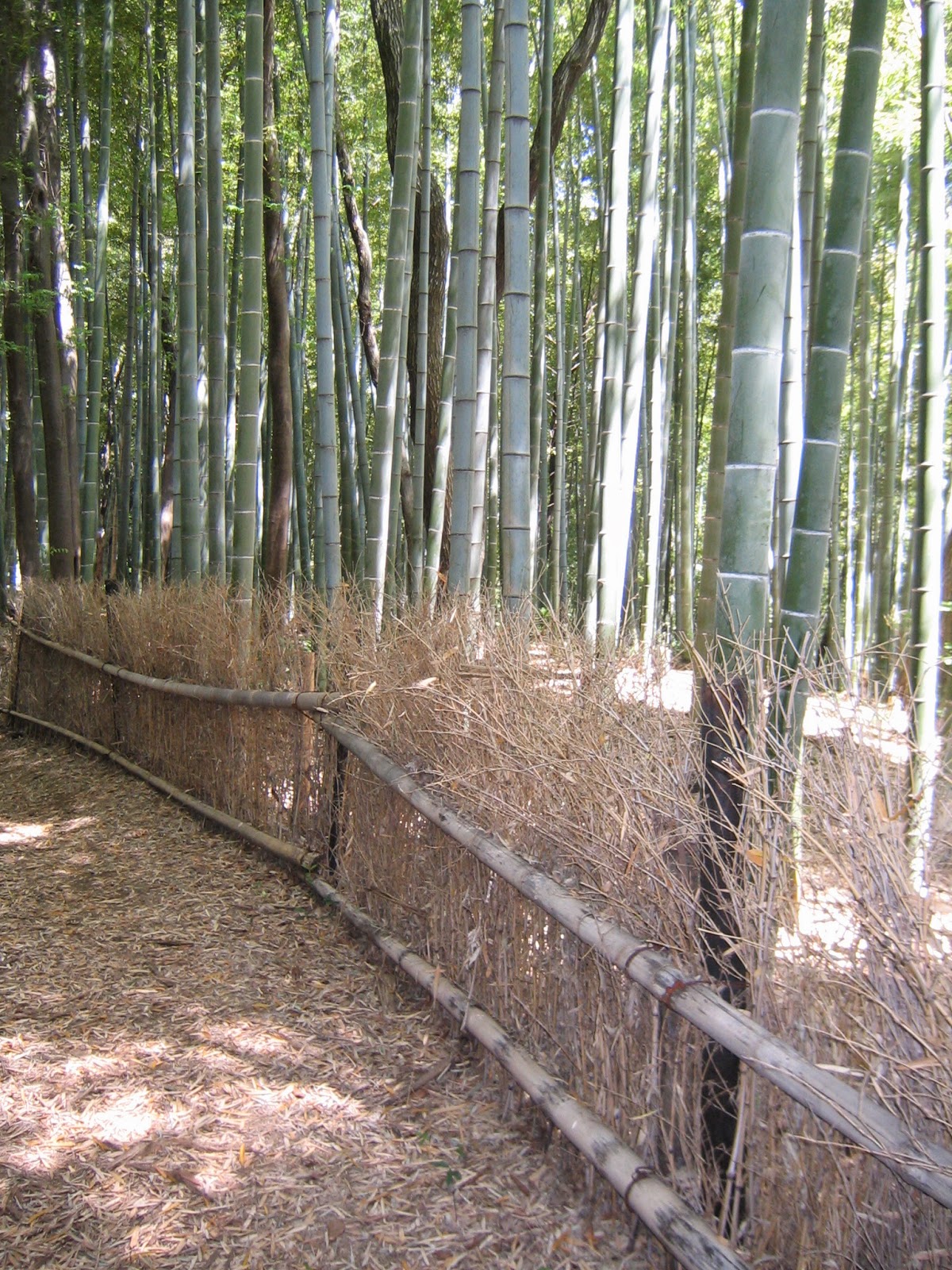
The forest we can see directly from Okutsu House is called Mukaiyama 向山. Mukaiyama means “The hill on the other side.” I guess the name comes from the fact that the area spreads over the opposite side of houses standing next to Okutsu House. Those are the residence of people who actually work in the field of Asahi-Yato 旭谷戸 which we’ve visited in the previous post, “Spring in Satoyama.” Mukaiyama has magnificent Japanese cedars, Japanese cypress, and bamboos.


i.e., Basically Mukaiyama is a cultivated forest for generations. Coniferous forest is for traditional construction materials in Japan, and bamboos are for tools of daily activities, such as baskets and utensils. And hence, Satoyama Center has a regular bamboo basket weaving class. Especially in spring, bamboos provide seasonal delicacy of bamboo shoots, takenoko たけのこ.


If you find bamboo shoots this large, it is too hard to eat already. Let it shoot into the sky.
Normally, people harvest bamboo shoots in early morning. An expert walks in a bamboo forest in soft-sole flip-flops to feel the tip of the shoots still beneath the surface. Finding it, s/he digs it out of the ground, then as soon as possible boils it to get rid of astringent taste. After this procedure, the shoot is ready to be cooked for stew, salad, tempura, etc. It is a typical spring dish in Japan, and hence many people, including thieves, want to dig them. In a beautiful bamboo forest of Niiharu,


there is a warning sign saying “This land is a private property. Digging out bamboo shoots without permission is a crime.”


Aside from culinary and artisanal usage, bamboos were used for flooring at least in Kanagawa Prefecture until the middle of the 19th century. Before Meiji restoration, Niiharu area was a part of land directly controlled by Tokugawa Shogunate in Tokyo. The regulation over the way of living for ordinary people was harsh and strict as Sagami-no-kuni 相模国 (the ancient name for the major part of Kanagawa Prefecture) and Musashi-no-kuni 武蔵国 (the past name of now Tokyo, Kawasaki, and a part of Yokohama) were so near to the castle of Shogun (which is now the Imperial Palace).Ordinary people who lived in the current northern part of Yokohama had to ask special permission from Shogun to construct a house with wooden or tatami-mat floor, as they were more expensive than fast-growing bamboos. Bamboos are easy to be bristled so that it requires frequent changes of floors, i.e. a greater demand for bamboos if they are for floors. The local seniors of Niiharu say in a-matter-of-fact way that any farmers with land (i.e., the ancestors of current landlords of Niiharu) had to have a well-cared bamboo forest. The large bamboo forest in Mukaiyama is the remnant from the time of Shogun. Mukaiyama also maintains the bushes of Sasa veitchii which was once ubiquitous in Yokohama, but now in near extinction.


Sasa veitchii is thriving beneath the canopy.
If you choose to enter from D-1, next to A-1, a small route along the orchard soon brings you to a farm land.


D-1 entrance
I think they are plums.
Mukebara

It is Mukebara 向ヶ原, aka “Niiharu Megumi-no-Sato (Niiharu with blessings) 新治恵みの里,” that is used for educational farming activities operated by local landlords. The harvest from here appears in Farmers’ Market every Saturday.

Between Ikebuchi Hiroba 池ぶち広場 and Miharashi Hiroba みはらし広場, the route is wide enough for a small truck to carry necessary supplies for the maintenance of the Forest. If you are with babies in buggies, you can take the Ikebuchi Route (from A-1 to A-8) for picnic. Ikebuchi Hiroba has faucets for potable water and several picnic benches some of which is under a magnificent canopy of wisteria in full-bloom early May.


Ikebuchi Hiroba also has toilets, with paper, but no soap.


Local mums bring their kids by bikes to Ikebuchi Hiroba for picnic.
The south of Ikebuchi Hiroba and beyond Mukebara is, really, a forest. According to the Revival and Re-energizing Plan for Niiharu Forest, the area is defined as the habitat for (almost) natural fauna and flora of Niiharu. A large group of people (e.g. 100 or more) is positively discouraged to visit the area. A group of 2 or 3 people would be the maximum. (If you plan to have a school excursion, please make a contact with the Office listed below.)


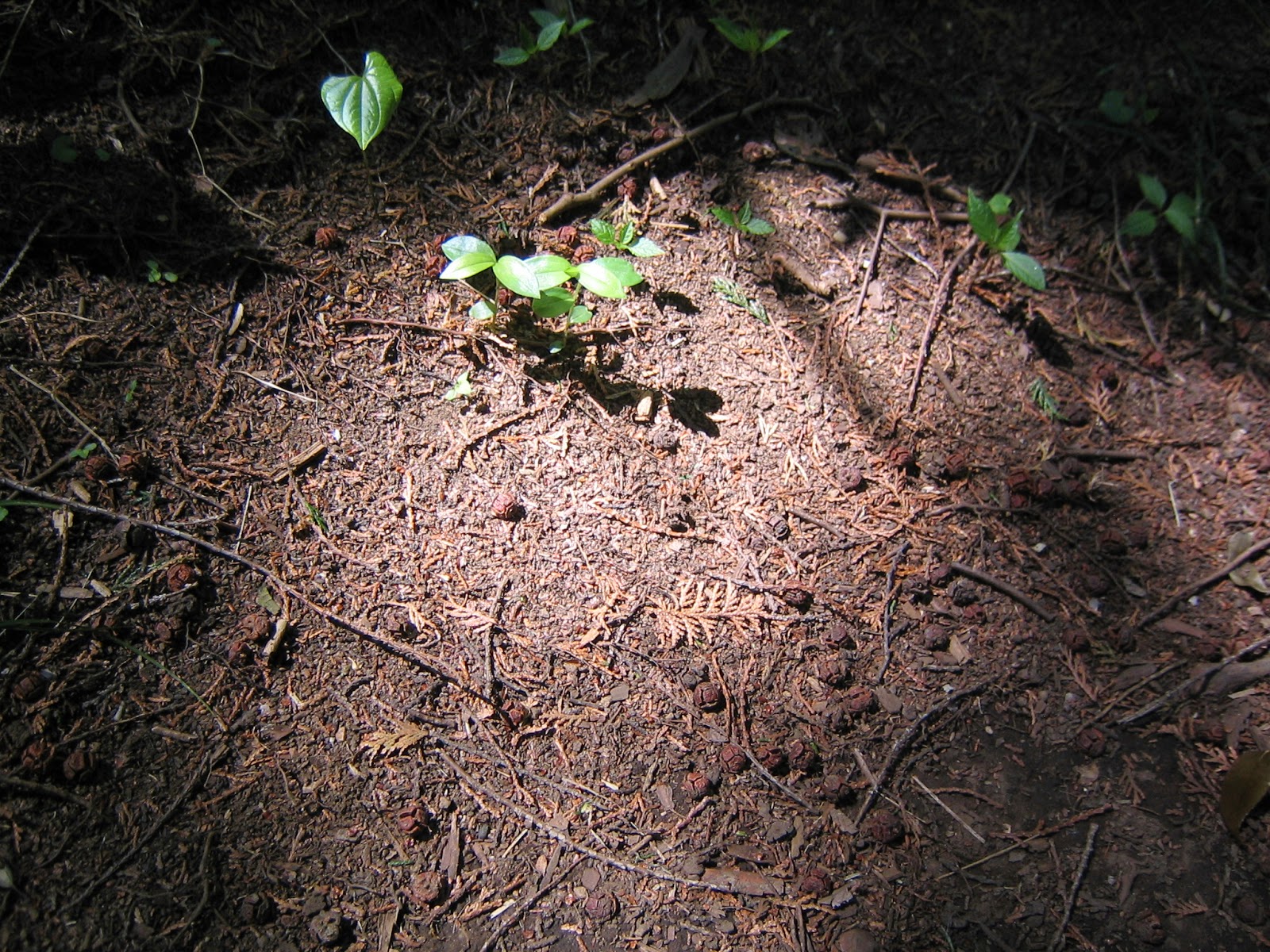
It’s not artificial spot light. I just took a photo of the ground near E-5, one fine day.
Around D-10. The route is really well-kept.
A scenery near D-8. Can you figure out a parking for Yokohama Zoorasia in the middle? 
And suddenly we find logs for Shiitake Mushrooms in the Forest!
The eastern area between Route E and Route D is called Yaman’me Yama やまんめ山. Before, this was the point where people could find many wild silk warm cocoons. (“Yaman’me” means “cocoons of wild silk worm.”) Wild silk cocoons produce the best quality silk so that this hill was really a wealth factory. Now it is the area for regular summer news for wasp and mamushi attacks.


A warning for wasp attack!
The entire experience in the southern part of Niiharu Forest is meditative and really refreshing. Let’s just be modest, as we humans are intruders of family life for wasps and snakes. Don’t be greedy for silks …

If you find a problem in the Park, please make a contact with

Office for the Park Greeneries in the North北部公園緑地事務所
Yokohama Municipal Government Creative Environment Policy Bureau横浜市環境創造局
Phone: 045-311-2016 (I guess in Japanese only)
FAX: 045-316-8420 (I hope there is somebody who can read English …)

Niiharu Administrative Office / Satoyama Exchange Center新治管理事務所・里山交流センター
Phone: 045-931-4947
Fax: 045-937-0898
http://www.niiharu.jp/