Sunday, March 2, 2025

Very Dry: what’s happening in Yadoriki Water Source Forest やどりき水源林?


It’s dry these days in Kanagawa Prefecture. Although we do not suffer wildfires like in Ofunato 大船渡 or LA, the dryness of our atmosphere can prick our skin … Having said that, it might be a natural thing for our climate. Here is the total amount of rainfall for each January since 1997 around Lake Tanzawa, a neighbor of Yadoriki Water Source Forest.
Sure, 2025 is in the lower precipitation group for January. But there were drier years before … We may not have a problem. However,


These are water blankets found in Yadoriki Stream in January. It spread widely over the water surface.


Normally in our climate, water blankets proliferate when the temperature of water is warm enough, like around 20°C. During our research of the river in December, the average water temperature for Yadoriki Stream was around 10°C, chilly enough for preventing water blanket mushroomed. In January, the precipitation was small and … the water might have warmed more than for average years … Globally warm winter? We were alarmed, and reported the incident to the Prefecture. We‘re watching the situation.


If you find environmental issues in Kanagawa Prefecture, please make a contact with Kanagawa Natural Environment Conservation Center 神奈川県自然環境保全センター

657 Nanasawa, Atsugi City, 243-0121
〒243-0121 厚木市七沢657

Phone: 046-248-0323

You can send an enquiry to them by clicking the bottom line of their homepage at http://www.pref.kanagawa.jp/div/1644/


Sunday, February 23, 2025

Pounding: making mochi cake at the top of Mt. Kobotoke-Shiroyama 小仏城山


Rice cake, mochi in Japanese, is popular in Japanese cuisine. It’s made of steamed sticky rice pounded enough to be the rice gummy. It takes a certain effort to make it. In yesteryears, it was a regular menu for village festivals and served each community member as a token of celebration. The time when Japanese consume mochi most must be for New Year Celebration. It can carry symbolism of the tradition, like Hot Cross Bun for England. Having said this, now in the 21st century we can purchase it all year round from supermarkets, neatly wrapped and ready to be popped in a toaster. Traditional meaning aside, making mochi is a fun group activity. So, please try Aotengu mountain café 青天狗 at the top of Mt. Kobotoke-Shiroyama 小仏城山. This week I tell you my adventure of mochi-making there.

That day, Mt. Fuji was beautiful ...

First, where is Mt. Kobotoke-Shiroyama? It’s the next peak from uber-popular Mt. Takao 高尾山. How to go Mt. Takao must be explained a lot in the travel guides for Japan or Tokyo. I omitted the itinerary today. Between Mt. Takao and Mt. Kobotoke-Shiroyama, I posted travelogue several times in this series, including the route for enjoying the “most beautiful cherry blossoms in Tokyo (; my posts for February 25, March 4, March 11, 2022). Please check these if you like. In any case, although there are several branch trekking ways between Mt. Takao and Mt. Kobotoke-Shiroyama, it‘s a simple one way direction. The majority of branch roads meet soon several times, or join at the top of the mountain at the end of the day. + It‘s uber popular hiking course. You simply join the crowd, and Mt. Kobotoke-Shiroyama is just there. As long as you wear good shoes + hiking gear and carry enough water, don‘t worry ... er, it‘s becoming problem these days accidents are happening too often especially among overseas visitors who are not at all prepared for hiking. Although it‘s not Mt. Everest, the mountain is a mountain, and we must get ready for walking such environment even if it is for Mt. Takao. There are of course the other routes reaching to Mt. Kobotoke-Shiroyama skipping Mt. Takao. It’s a bit complicated operation, including finding bus stops or entrance to hiking course, etc. So, I skip these today: main topic is POUNDING MOCHI!

Along the route,
there are many maps showing the routes around Mt.Takao.
 Follow these directions together with your fellow hikers.

Actually, the most important thing for having rice-cake fun at Kobotoke-Shiroyama is Making Reservation. From their HP of this, there is a reservation link. The café Aotengu 青天狗 moved from the neighboring peak of Mt. Kagenobu 景信山 last March, and with this they transfered mochi-making service to the top of Mt. Kobotoke-Shiroyama. When you make reservation, please tell Mr. Aoki, the owner of the café, the date and expected arriving time of your party. In order to make mochi it is needed one overnight soaking of rice before steaming them, and so RSVP. Also, you need to confirm your mochi-making by 15:00 of the day before of your fun. Oh, I have to add this: you cannot make mochi alone. At least two people are needed, and Aotengu does not offer variety of portion: 3kg of sticky rice only. We’ve been there 6 people, 5 males and me, ate mochi enough, and could prepare souvenir for 7 families. You see? Mochi-making is the thing of festivals!

Aotengu Café

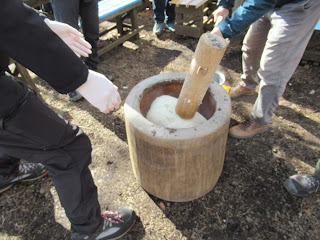
Aotengu Café prepares the tool for mochi pounding (mochi-tsuki in Japanese), i.e. a set of pestle and mortar, and 3kg of steamed sticky rice, for around 9000 yen. As these days the price of rice in Japan is super volatile, please ask café how much it is now. The Aotengu also can lend us a portable stove, a deep pan, and a ladle, all of which are in separate charge. We brought by ourselves these tools + lots of H2O, hand sanitizer and plastic gloves for serving food. Mr. Aoki said OK for this. H2O is very important as there is no water source at the top of the mountain, you know. However, if you bring in alcohol drink by yourselves, Mr. Aoki will charge 1000 yen per person, as his café sells such beverages. Please be a nice customer for Aotengu. Aotengu Café also advertise special relish for enjoying mochi cake, i.e. minced Japanese leeks mixed with yuzu-taste miso paste. Or you can bring your own condiment and the other ingredients for your mochi dishes. It’s OK. By the way, eating mochi with butter and soy sauce is very popular these days. Tomato sauce or olive oil with salt also goes well with mochi. The menu with mochi could be infinite if you like. Mochi with cheese and chocolate sauce is also my favorite 😊.

Steamed 3kg of sticky rice,
situated neatly in a large mortar.
 Traditionally, Japanese mortar for mochi pounding is
 made of a large trunk of Japanese zelkova,
hollowed out for this usage.

When the rice is ready, we need to work with it quickly.
First, mash the rice with pestle.
Oh, you’d better wet the pestle before the start.
 Otherwise, the rice sticks to it,
and mochi pounding becomes messy.

Mashing …

until the rice becomes this level of gooeyness.

Then, turn over the now so-so gummy mass
of sticky rice upside down.

Finally we start pounding.
Don’t waste your time reaching to this stage.
Rice still must be very hot.
Several times of pounding,
then another person turns over the rice.
 Continue the routine.
 So we need at least two people for mochi making,
 in order to avoid cooling of rice in the process.

The key to pounding is
using gravity working on the heavy pestle.
You wind the pestle up, aim the rice, then,

swing down the pestle.
I tell you
hitting the rim of mortar is not a rare thing.
It requires a certain technique
for smooth pounding.

Almost there …
the rice cake still must be hot at this stage.

The other things we noticed we should have brought were

1. Corn starch and clean operation sheets like perchment paper for bakng. After pounding mochi-cake, we have to divide a mass of mochi into at least a loaf size or smaller. At the top of the mountain, there are only outdoor picnic benches which is not suitable for working with food on it. We managed with the things we brought this time, but reminded ourselves next year we’ll be more organized. 

2. More variety for condiments/relish to enjoy mochi. We brought only soy source and nori seaweed, which is a bit too simple for rice cake for roughly 20 people. I really regreted I have not brought cheese and chocolate sauce …

Done.
We forgot bringing corn starch and operation sheet
 … only chop sticks.
Hmmmmmmmmmmm.

Things worked out somehow.
We had it with soy sauce, nori seaweed,
and sweet soybean flour.
We also cooked soup with carrots,
Japanese leeks, chix, and mochi.
It was a cold day.
Hot mochi was delicious.

Anyway, it was really a fun. Also we must be in a hurry for mochi-tsuki as we have to finish our task when the steamed rice is hot enough to be glutinous. Yeah, we must preserve our energy for doing this after going up the mountain. But empty stomach does not have to wait for long ... er I’m not sure if it is a suitable activity for hot summer … but it is certainly very popular entertainment. Aotengu Café said by the end of this March all the reservation is taken as of today. The chance to enjoy mochi pounding at the cherry blossoms season maybe for next year? Please consider.

Megalopolis Tokyo over there …

If you find environmental issues in Kanagawa Prefecture, please make a contact with Kanagawa Natural Environment Conservation Center 神奈川県自然環境保全センター

657 Nanasawa, Atsugi City, 243-0121
〒243-0121 厚木市七沢657

Phone: 046-248-0323 

You can send an enquiry to them by clicking the bottom line of their homepage at http://www.pref.kanagawa.jp/div/1644/

Sunday, February 16, 2025

Yearning for Spring: Plums have finally started to bloom in Yokohama


I think this winter is a sort of erratic. One day, it’s very warm like a spring day. Then Japan-sea Polar airmass Convergence Zone (JPCZ) came to snow madly in several areas of archipelago. Yokohama has so far been spared from disruption by snow, though it was damned cold last week. Maybe flowers are also confused. I feel the blossoming of plums is late this year. But finally this week, they started to smile in Yokohama. As of February 16, plums in Yokohama are still 30% or so opening … still, it’s something we’ve been waited.


One plum blossom

    One blossom's worth of warmth

                Hattori Ransetsu

                (Translation by Koichi Otsu.)


梅一輪

 一輪ほどの暖かさ

                    服部嵐雪


Ransetsu is a disciple of Matsuo Basho.


If you have any questions about Yokohama’s Green Tax and Green Up Plan, please make a contact with

Strategic Planning Division, Green Environment Bureau, City of Yokohama
横浜市みどり環境局戦略企画課

Phone: 045-671-2712

FAX: 045-550-4093

Email: mk-kikaku@city.yokohama.lg.jp


Sunday, February 9, 2025

Epilogue: After urbanization and endangered Asarum tamaense Makino


Stachyurus praecox in Tama Hill

In 1931, Dr. Tomitaro Makino (; my post on October 27, 2023) named a species of Asarum (; my post on May 6, 2022) found in Kawasaki. It is called Asarum tamaense Makino. As it is in the genus of evergreen Asarum, it loves humid forests with leaves sprout out straight from the ground and flowers with brownish calyx stick to the soil. Asarum can move VERY slowly from the place parent plants locate. Estimated speed of its movement is about 1 or a couple of kilometers per 10 thousand years. i.e., it has time to evolve adjusting to a particular environment where the “original” established (literary) its roots. Actually, Japan has 50 known independent species of Asarum each of which is exclusive to a very limited geographical area, similar to Darwin finches in Galapagos. In 2020, a team of botanists led by Dr. Yudai Okuyama of National Museum of Nature and Science published in Annals of Botany their findings from DNA sequencing for almost all (mainly) Japanese Asarum. They theorized when Japanese archipelago was a part of Eurasian Continent 7 to 10 million years ago, the ancestors of these local Asarum moved from a part of now-China, and diversified their DNA pattern suitable for each distinctive environment where they stay for a very long run. Environments of Japanese humid forest floor can be different even between the neighboring small valleys, and hence we have many species of Japanese Asarum. Asarum contributes to a high biodiversity of Japanese nature.

Asarum tamaense Makino
 in a forest of Kanagawa Prefecture.
I won‘t tell you where I found them.

For the case of Asarum tamaense Makino, it has adjusted the climate of suburban Edo (aka Tokyo) whose soil is fluvial strata created by Tama and Tsurumi Rivers + volcanic ash from Mt. Fuji. DNA-wise it is locally very unique species spreading on the eastern edge of Fossa Magna region. Asarum tamaense was once ubiquitous in Tama Hills and little bit of Sayama Hills. Oh, by the way, it was the area where a massive housing development occurred during the 1960s and the 1970s. Please guess what happened to Asarum tamaense. Nowadays it’s a rare occasion finding Asarum tamaense in local neighbourhoods. Many survived Asarum are in college campuses where professional botanists roam, or in town where the landlords close the access to their land ... Moreover, as Asarum genus loves humid forest floor, drying ground accelerates the demise of their species. For example, if you leave ordinary forest on Tama Hills without proper management, sasa bamboos cover the floor completely. The spread of sasa roots over the surface of ground obstructs rainwater to seep in. Asarum tamaense will die for thirst. Now, Asarum tamaense Makino is nationally designated Endangered Species.

Once
people become not caring about forest floor in Tama Hills,
Sasa bamboos dominate.

The story of Asarum tamaense Makino is related to the issues surrounding Yokohama‘s Citizen Forest, don‘t you think? Normally, they flower in April, but in this boiling climate it might be earlier this year ...

Flowers of Japanese raspberry
which flower the same time as
Asarum tamaense Makino.
I took the photo in Tama Hills.

If you have any questions about Yokohama’s Green Tax and Green Up Plan, please make a contact with

Strategic Planning Division, Green Environment Bureau, City of Yokohama
横浜市みどり環境局戦略企画課

Phone: 045-671-2712
FAX: 045-550-4093 

Sunday, February 2, 2025

Friends of Friends: Lovers Associations for Yokohama’s Citizen Forest


In a sense, the strategic designation of Urbanization Control Area and Lovers Association System are two sides of a coin for Yokohama’s environmental protection. First, the city secures green spaces from rampant urbanization pressure. Then, the policy introduces the forestry and “gardening” by Lovers Association to stop the preserved forests degrading into a damping ground for social nuisance. When the city gave preferential tax treatments for landlords allowing their property to be Control Area, the office put the condition in the contract for the title holders to form or collaborate with “citizen volunteers group” who engage in forest management. As a carrot, the city pays a Lovers Association based on the length of strolling path within the Citizen Forest, where the Lovers are expected to keep it safe for visitors enjoying the forest. By becoming the leader of a Lovers Association, the landlord shares this subsidy with the other members of the Lovers, and says “thank you” to the volunteers maintaining his/her property.


So, the majority of Yokohama’s Citizen Forest has Lovers Association which was formed by landlords, their relatives, and/or old acquaintances. It’s not anomaly for these groups to limit the membership. In this regard, Niiharu is one of the exceptions as the Lovers Association does not have any condition to be a member. Here is the latest list of Yokohama’s Forest Lovers Associations which allows anybody who can join the volunteering. The number of the groups in the catalogue are far smaller than the number of citizen forests and smaller forests registered at the city for environmental protection. Why are many Lovers closed community? The reason is obvious. The land is a private property. Yes, the landlord agreed to open his “garden” to the public for strolling. But yielding saws and sickles within his/her assets is a different matter ... It is already 50 years since the Citizen Forest System was inaugurated. The system has worked well. Yokohama has become a city with green spaces here and there. Yes, landlords are grumbling, but they also have preferential tax treatment and subsidy for maintenance of their estate. In the end it’s not so bad deal, is it?


Unfortunately, the scheme may be approaching a critical point. The culprit is rapid aging of society. Imagine, you landlord is now an octogenarian. You are the leader of a Lovers Association for your forest. The member of your team is long-time friends of yours. You guys have had a good time enjoying large-scale gardening in your asset. And the average age of your team is … octogenarian. Maybe you have kids. They are Hamakko, proud city slickers. They also are not young, maybe in their 40s or 50s, the prime age as working force for Japanese economy, i.e. busy. Yes, they know their dad has not so small land in Yokohama. They will inherit it. But

(1) they are not interested in dirt works of forest management, and/or

(2) they do not want to manage their dad’s human relation in Lovers Association. 

They plan to pay inheritance tax, period. No thank you for continuing dad’s pal-circle. The closed nature of Lovers Association guaranteed a certain level of forestry output, but it has now led to a serious problem of generational change and the resulted labor shortage. Lots of Lovers Association for Citizen Forests face currently the problem of continuation, i.e. sustainable existence.


The city office is in damage control mode. For example, take Jike Citizen Forest (; my post on October 7, 2015) which is, maybe, a property of proud descendants of Samurai with family tradition of at least 900 years. Unfortunately, the forest now does not have a team of Lovers who takes care of the maintenance of ancestral land. It could mean some inheritance incidents would have occurred lately and heirs may have paid their inheritance tax with land ... I don’t know exactly what happened. But one thing is for sure: the City of Yokohama hires professional landscapers to clear the undergrowth along the strolling paths in Jike Forest, which is normally done by Lovers Associations. The office also organizes a couple of “fun forestry day for anybody who can come to the Jike forest” in a year. Is it enough? … Yokohama is in the climate zone for temperate rain forest. The maintenance requires more than a couple of days per year for the forest to be at least comfortable to walk, let alone preserving biodiversity. Jike’s forest is rapidly becoming dark due to overgrowing trees and bushes. Comparing, say, nearby Kurokawa Forest (; my post on December 15, 2024) on the edge of TamaHills, the difference is now apparent. I doubt if the Jike forest maintains variety of living creatures which just a couple of years ago welcomed us in a nicely maintained forest …

Commercial rice cultivation is continued in Jike community.

Though, the forest circling the rice paddies is …

Pro-landscapers mechanically mow the grass
to 1m inside the forest from the path.
Er, OK, good job.

It’s not a unique example. Shomyoji Temple Citizen Forest (; my post on December 4, 2015) does not have Lovers Association either. Masakarigafuchi Citizen Forest (; my post on August 21, 2015) is lucky. When its Lovers Association was seriously preparing for closure, a group of young neighbors happened to visit the forest. They were interested in the forestry work and the retiring guys and the City persuaded them to “inherit” the management of Masakarigafuchi Forest. Not all the forests in Yokohama are so fortunate …


And so, the conclusion comes to the word of “Coordination Saves the World” again. Tokyo was once engulfed with enthusiasm for bulldozers. Now it has only large parks. Yokohama has managed to keep neighborhood greenery in urban environments so far. But we are in the middle of rapid demographic change. In this new world, closed associations cannot achieve even status quo. To sustain our success, we need cooperation of neighbors, especially new and young people next door who have potential to pass the baton for the next 50 years and beyond. The problem is how to find such people. The saving grace is these days kids in Yokohama are taught SDGs in schools and know, at least in textbooks, the importance of sustainable greenery that can lead to poverty reduction and coordination for world peace. Let us see how we can go from here …


If you have any questions about Yokohama’s Green Tax and Green Up Plan, please make a contact with

Strategic Planning Division, Green Environment Bureau, City of Yokohama
横浜市みどり環境局戦略企画課

Phone: 045-671-2712
FAX: 045-550-4093
Email: mk-kikaku@city.yokohama.lg.jp


Sunday, January 26, 2025

Checkmate: Games of Chess and Yokohama’s Citizen Forest


Take Niiharu Citizen Forest. It‘s the largest Citizen Forest of Yokohama. The landlord who had the biggest acreage was Mr. Okutsu who unfortunately died in 2000 just before the inauguration of the Citizen Forest (; my post June 24, 2016). He did not have a person who could inherit his property or negotiate with the city what to do with the title of the land. Upon his death the land he owned became municipal property. The remaining landlords of large or else are still counted about 90 people for Niiharu. Do you think they easily agreed to aggregate their land for becoming urbanization control area? We Japanese were/are not so good people. Niiharu is not an exception. It’s a typical land-ownership pattern for Yokohama’s Citizen Forests, large and small. Under this constraint at the time of forming citizen forest network, the city’s planners must have worked strategically to make the forest “Citizen Forest” with the designation of Urbanization Control Area. They fully utilized small meshes covering the entire city.

Lots of landlords for Niiharu

Imagine you had a land, maybe 10m*10m?, within a certain mass of greenery of Yokohama. The next to your forest had another landlord. Actually your land was surrounded by several neighbours who owned ecologically similar forest of small patches. Now, one of the neighbours agreed to make his/her land Urbanization Control Area. Another neighbour decided to sell the property to the City, Prefecture, or even to the National Government. Maybe, the person or the heir used their property for tax purposes. (Well, Niiharu Citizen Forest has several small areas of national land. In a sense, Niiharu Forest has National Park within it.) They were tiny, but eventually, say in 10 or 20 years’ time, your land could be encircled by Urbanization Control Area. One day, you noticed you did not have access to your land unless you passed the Urbanization Control Area. You had insisted to keep your land OK for urbanization at least legally. But you did not have legitimate way anymore to bring bulldozers for constructing “urban“ place on your land. Moreover, did you think easy to connect your property with electricity, water and sewage system of the city? You had to run around many offices for permit etc. Finally, even if you planned to sell your 10m*10m land for a housing developer, did you think there was a buyer for such land?

This part of Niiharu is owned by
the mixture of private and municipal landlords.

For officials who plan to preserve green spaces within the city, that‘s the strategy exploiting the small meshes over the area. Lots of landlords with the equal property right means the diverse idea of land management for each mesh. Within about 100 landlords for 70ha, which is Niiharu‘s case, there is no single policy agreed to manage the greenery. That‘s the point of start. For an official who aims to expand the protected area, the first task is to find title holders who sympathize the environmental protection. The reasons why they think so could be different, but they all agree importance of preserving the ecology of the land. That’s more than enough. Such landlord could be persuaded to make the acreage Urbanization Control Area. If one corner of a land obtained the title, and the landlord started enjoying preferential tax treatment and/or almost free help for land management including weekend forestry by Lovers Society, their neighbour may begin to think the option of making their property also under the Control Area. The next job of the city officer is to find or nudge the neighbours into such direction. Little by little, the property of “against Control Area” would be checkmated. It has been a long, patient, and often unsung or even disliked duty for the city officers in order for keeping the city green. But they were/are very clever. They played chess games, or Go games, for a long haul. They have succeeded. Look. Now in 2025, Yokohama has 47 Citizen Forests and numerous smaller green spaces here and there.

Viola keiskei Miq in Niiharu,
preserved thanks to Urbanization Control Area designation.

The strategy game does not end with the demarcation for Urban Control Area. Yes, once awarded the title of “Urban Control Area,” removing the label requires long legal procedure that often does not match with the benefit from urbanization of the land. (In the end, it’s the system defined by national law passed and modified by National Diet.) Still, for landlords to enjoy the advantage offered by the municipal government, it is based on contract with the city. For example, basically every 10 years landlords for properties within a Citizen Forest have chance to revise and renew their contract with the city. Before, maybe, the title holders lived near the forest. During these 50 or so years, many original members passed away and their relatives inherit the property. The passing of legal title has done with preferential tax treatment for Urbanization Control Area … And now, not every heir lives near, or even in, Yokohama. Some of them may have established their own household in, say, the USA. To maintain Citizen Forest, the city officers must negotiate every landlord, for Niiharu’s case 90 of them, wherever they are on the planet to reach an agreement for the next 10 years’ land-usage. The discussion can take for years. Do you think it’s easy? The most difficult task for local civil servants in charge of Yokohama’s greenery is to get hold of the time-limited agreement with these various landlords.


That’s the way how Yokohama secures green spaces within the city, different from Tokyo. But it’s not all. Aside from the periodical revision of land contracts, the city must think about how to keep environmentally secured land free from nuisance or even crime. Under our climate of temperate rain forest whose dominant vegetation is evergreen broad-leaved trees, leaving the greenery without human intervention must make the forest very untidy and dark. The existence of such space in a crowded city of 4 million people invites crime next door. Besides, dark and untidy forest surely has lower biodiversity which is a perverted result for environmental management with Urbanization Control Area. Here comes the system of Lovers Association. I will tell you about it next week. 😉

This part of Niiharu was a veggie field around 1945
when the entire nation was starved due to the War.
80 years later, Lovers engage in regular maintenance
to make the forest floor bright,
which is important for the vegetation to sprout.

If you have any questions about Yokohama’s Green Tax and Green Up Plan, please make a contact with

Strategic Planning Division, Green Environment Bureau, City of Yokohama
横浜市みどり環境局戦略企画課

Phone: 045-671-2712
FAX: 045-550-4093 


Sunday, January 19, 2025

Haste May Make Waste: Japanese Planning Act for Tokyo and Yokohama


Hamakko (= a child of Yokohama)

First, in defense for Tokyo. As a capital city the development pressure on her is always greater than for Yokohama. In addition, there was 1964 Tokyo Olympics that hurried the city to rebuild ASAP from the post war rubble. It must have been under such atmosphere the farmers around Shibuya happily sold their ancestral land without much ado about natural environment. Yokohama’s landlords at that time did not have the pressure of the same level. Lucky for forests, but unlucky for landlords maybe, the title holders could own their property without any worry as before at least till 1968, the year when Japanese City PlanningAct became effective. Just 4 years difference could have done a huge difference on local forests between the two cities … And it may have reflected how officials in townhalls operated based on the 1968 Act.

At the entrance for Niiharu Citizen Forest,
houses of landlords are standing.

In Tokyo, when the local civil servants drafted city planning, their way of drawing borders was a very rough sketch. They demarcated a large area for “business district,” “commercial area,” “industrial area,” “housing,” … In this approach, it must have been natural for designation for Urbanization Control Area based on already existed large public parks, such as Shinjuku-Gyoen, Inokashira Park, etc. And in the process, small forests remained in between these large established parks were assigned to be OK-for-clear-cutting (… maybe like the original idea for the 21st century redevelopment of Jingu Gaien …). They were all destroyed, small farms were bulldozed, and rows of concrete structures were constructed. The result is the aerial view of Tokyo we can have when we depart from Haneda Airport: almost a carpet like continuation of buildings with occasional large green patches for Imperial Palace or the like.

This scenery would be inevitable for bayside area of Tokyo,
all reclaimed land artificially.
Still, almost no green to speak of ...

And this is a part of Meiji-jingu Shrine, Tokyo,
which is the official sanctuary for Japanese Emperor Meiji.
Of course,
this place is designated for Urbanization Control Area.

Yokohama was different. For one thing, people could have time, without the absolute deadline for Olympics, or the else. Landlords were not hurried for decision. City planners were able to ponder how to draw the lines. So, a master plan for city development consisted of small meshes covering the entire city. The demarcation between urbanization and urbanization control areas was far intricate than for Tokyo. One block, maybe 10m*10m, was designated for manufacturing zone which stood next to the urbanization control area of a tiny forest surrounding an old Shinto shrine. The luxury of time also allowed stake holders to negotiate enough. True, the title of Urbanization Control Area could give lots of headaches for landlords. But the city council and the townhall office can adjust the local and inheritance taxes based on the discussion with the landlords. Are you OK to let your ancestral land divided in rows of tiny houses on which you don’t have ownership anymore? Oh, I must remind you if you sell your farmland for commercial development you have to pay tax of considerable amount for your transaction. Instead, if you make your land Urbanization Control Area, you have preferential property tax treatment, and maintain your forest as is. Moreover, after your death, inheritance tax of your land levied on your kids will be discounted. Not a bad deal, don’t you think?

Male Daurian Redstart
relaxing in a winter farmland of Yokohama.

The offer must have been attractive especially for small title holders, which was/is common among Japanese farmers. Many landlords in Yokohama took the deal. Of course, there was a kind of sense of mission among city civil servants at that time. Do you remember a tale of Mr. Yoshikazu Asaba (; my posts for June 10 and 17, 2016)? I don’t say Tokyo did not have such officers at that time, but Yokohama surely had an advantage in terms of requirement of age. The merit worked well also for large mass of greens like Miho (39.5 ha), Segami (48.2 ha), and Niiharu (67.2 ha), etc. Forests. Let me explain.

Farmland attached to Niiharu Citizen Forest,
the Urbanization Control Area of Yokohama.

Among large forests in Yokohama, the entire area owned by single entity is only a handful. As long as I know such large title holders are the City of Yokohama (e.g. Yokohama Nature Sanctuary), Kanagawa Prefecture (e.g. Shikinomori Park of Kanagawa Prefecture), the government of Japan (e.g. Yokohama Park), owners of large golf courses (e.g. Hodogaya CC owned by Hodogaya CC Co.) and Keikyu Co. (owning Kanazawa Citizen Forest). Yokohama’s golf courses are one of the oldests in Japan, thanks to our history of the first modern international port for Japan. (Yokohama has lots of such advantages, probably as the favorite daughter for Japanese modern history. Please see my post for Doshi River.) The ownership of the golf courses has been established long before 1968. Landownership of Keikyu Co. is … it’s a long and complicated story of Japanese modern economy and politics since the 19th century, which is beyond the scope of this blog. What I want to say here is, the absolute majority of landlords for Yokohama’s large green spaces is small title holders. They en masse configure the large forests in Yokohama. Of course, they could see the merit of making their land for Urbanization Control Area I listed above. In addition, the negotiation the city took with these landlords would be the key why Yokohama now has lots of backyard forests. I’ll tell you about it next week.

Satoyama Garden, owned by the City of Yokohama.

If you have any questions about Yokohama’s Green Tax and Green Up Plan, please make a contact with

Strategic Planning Division, Green Environment Bureau, City of Yokohama
横浜市みどり環境局戦略企画課

Phone: 045-671-2712
FAX: 045-550-4093